On 28 April 2026, teachers, researchers, school leaders and project partners from FEDORAS and the five Open Schooling Networks gathered for the first International Change Lab. Bringing together 51 participants from diverse educational and national contexts, the meeting connected experiences emerging from the local Change Labs and opened them to collective reflection across the five networks.
At the heart of the local Change Labs is a movement from reflection to action and back again:
Explore challenges in our schools
Imagine new ways of teaching and learning
Co-design and test innovative practices
Reflect and adapt together
The experiences, questions and tensions emerging through this local work became the starting point for the International Change Lab. Brought together in a shared international space, they could be revisited across contexts, opening a wider reflection on what participants were beginning to notice about educational change.
“The International Change Lab is a moment to step back from local work and notice the system together.” — Olivia Levrini
Small windows into changing educational practices
The teacher contributions offered “small windows” into the work unfolding across the five Open Schooling Networks. They brought to the International Change Lab concrete experiences of experimenting with new approaches to teaching, interdisciplinarity, sustainability and futures-oriented education within their own contexts.
In Finland, teachers described how they responded to signs of disengagement with sustainability by creating a documentary festival to encourage more emotional and reflective approaches to complex global issues. In Greece, the focus was on exploring futures thinking through climate change and local problems, with teachers examining how different activities could make the relationship between present choices and future possibilities more visible.
In Italy, teachers reflected on interdisciplinary collaboration as a means of creating “third spaces” where different disciplinary perspectives could converge around shared cultural and artistic references. These spaces became opportunities for co-design, exploration and new forms of professional dialogue. In Spain, teachers worked across geography, history, biology and environmental perspectives through activities connected to the local territory, using fieldwork to rethink how learning could be organised beyond the classroom. In Norway, teachers experimented with comics, stop-motion animation and artistic collaboration within science education, exploring how unfamiliar forms of expression could open new possibilities for participation while raising new questions for teaching and assessment.
Together, these snapshots brought into view a rich and varied landscape of teaching in transformation across the five networks.
Learning to notice together
The teacher snapshots then became material for collective inquiry. Working in mixed groups, teachers, researchers and partners revisited local experiences through the three complementary FEDORAS perspectives — epistemic-cognitive, socio-relational and institutional. Across these dimensions, participants compared how knowledge was approached and learning organised; how relationships, participation and collaboration were evolving; and how institutional structures were shaping the possibilities for change. They also considered the tensions emerging alongside these developments, the conditions that sustained them, and the questions that remained unresolved.
A key idea running through this work was “learning to notice”: developing greater attention to changes that can easily remain unnoticed as new practices take shape. This included shifts in what teachers and educational communities recognise as meaningful learning, in how participation and relationships are understood, and in how emerging practices challenge established expectations. As Alfredo observed, changing how we teach and learn also changes how we notice what we value.
Participants paid particular attention to moments that “touch a nerve” — experiences marked by frustration, surprise, uncertainty, discomfort or curiosity. These moments opened questions that reached beyond the immediate situation in which they arose. Across the discussions, tensions around interdisciplinary work, assessment, curriculum structures, collaboration, time and institutional flexibility began to reveal connections between local experiences and wider educational conditions
Through these conversations, tensions arising from specific experiences began to intersect with wider institutional and cultural questions. Interdisciplinary work came up against curricula organised around separate subjects; collaborative and creative approaches exposed tensions within established assessment practices; experimentation required time, flexibility and support; and future-oriented education encountered tools and structures still shaped by more conventional forms of teaching and learning.
Rethinking what assessment makes visible
Questions about assessment emerged repeatedly throughout the International Change Lab. Teachers reflected on the difficulty of recognising and evaluating creativity, collaboration, systems thinking, participation and collective wellbeing within traditional grading structures. Across the local experiences, this took different forms: the Italian contribution highlighted tensions between standardised outcomes and broader formative approaches; in Spain, teachers considered a shift from evaluating predefined outcomes towards noticing more complex forms of participation and engagement; and in Norway, questions arose about how artistic work could be assessed within science education.
The breakout discussions brought the issue into sharper focus, particularly regarding how creative and interdisciplinary work could be evaluated fairly while supporting responsibility, agency and collective wellbeing. In the plenary reflection, assessment was linked to a broader question about what schools choose to value and which forms of learning their existing practices recognise.
This also connected back to an idea introduced at the beginning of the International Change Lab: assessment as inquiry, understood as a way of noticing, valuing and making sense of complex forms of learning.
Change grows through relationships
A further pattern emerged across the different contexts: meaningful change often begins through relationships before it becomes embedded in structures. Trust between colleagues, collaboration across disciplines, openness to experimentation, shared purpose and opportunities for reflection all appeared as important conditions for educational change.
Teachers also highlighted the value of working with researchers, universities and external partners, which brought new perspectives into schools and strengthened connections with wider societal challenges.
These processes took different forms across the five networks, shaped by each school’s institutional culture, curriculum, organisational structures and local context. Seeing these experiences alongside one another made it possible to recognise both the differences between settings and the tensions that recurred across them.
A learning community taking shape
As the reflections came together, a shared language was beginning to take shape across the five networks. Participants were developing common ways of discussing interdisciplinarity, sustainability, inquiry, participation and educational transformation, while openly acknowledging uncertainty and unfinished thinking. This sense of collective inquiry led Alfredo to describe what was emerging as “a learning community.”
The conversation also highlighted the challenge of sharing local educational experiences across countries and cultures. These experiences carry their own contexts, meanings and modes of expression — through narratives, images, emotions, metaphors and the voices of those involved. A FEDORA’s task is therefore to find ways to make local stories meaningful within an international conversation while preserving their richness and situated character.
“Part of the challenge is to find the way to tell local stories in a global way.” — Olivia Levrini
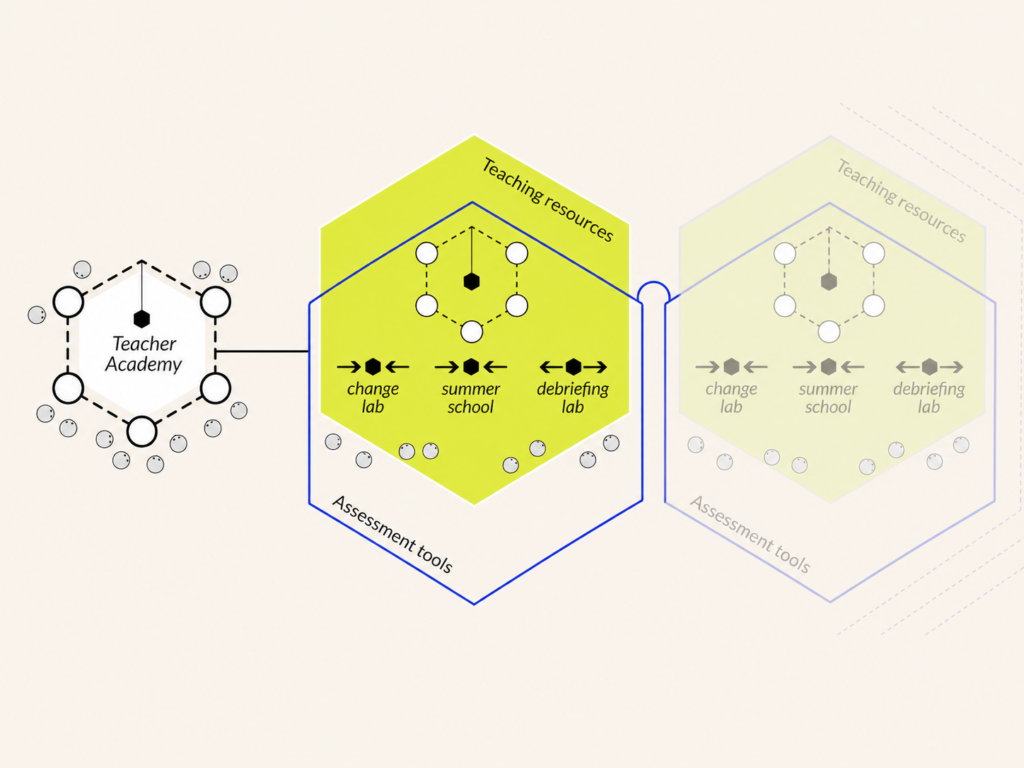
The International Change Lab also became part of a wider process of collective learning across FEDORAS. Local Open Schooling Networks, International Change Labs, Summer Schools and Debriefing Labs form an iterative cycle in which experiences are shared, revisited and carried forward into subsequent phases of the work.
The closing reflections therefore pointed towards continuation: sustaining the movement between local experiences and international dialogue, carrying emerging questions into the next stages of the project, and continuing to learn together across contexts.