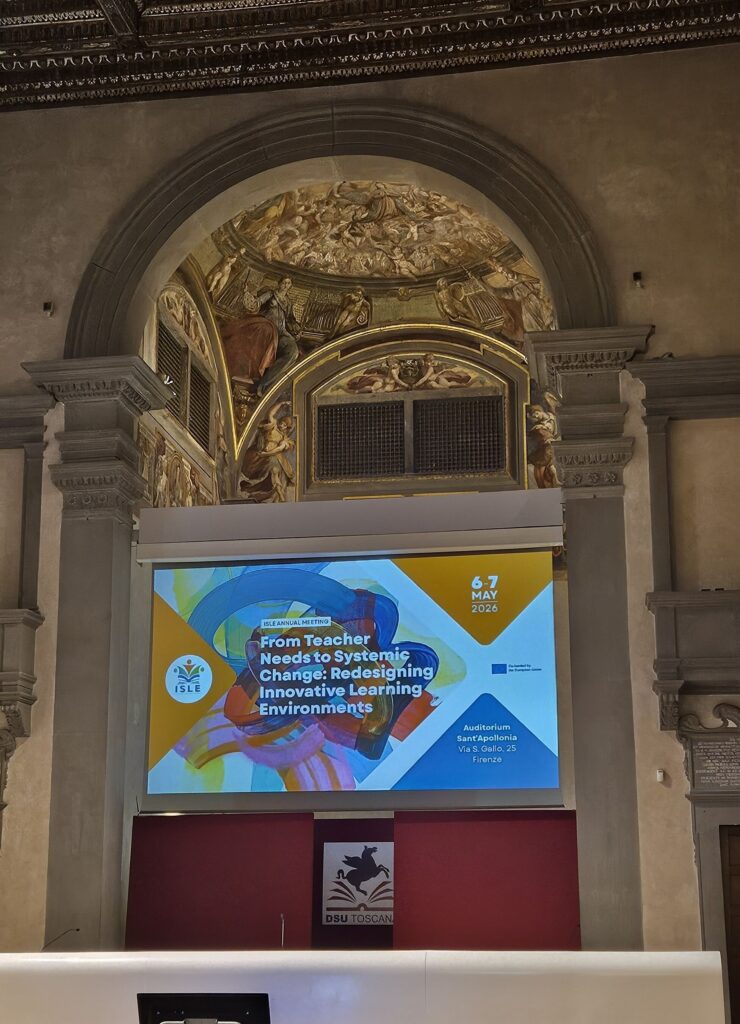
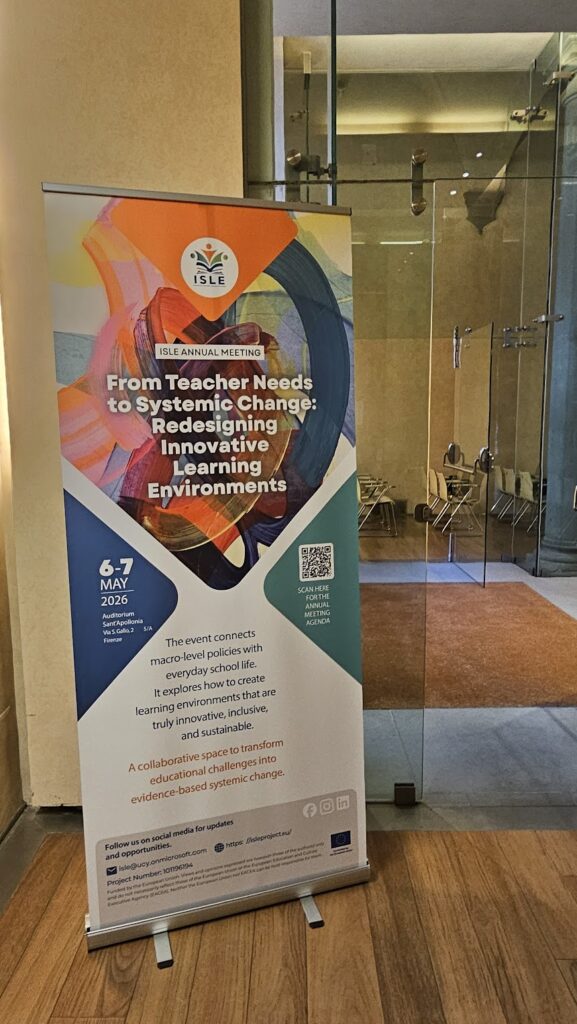
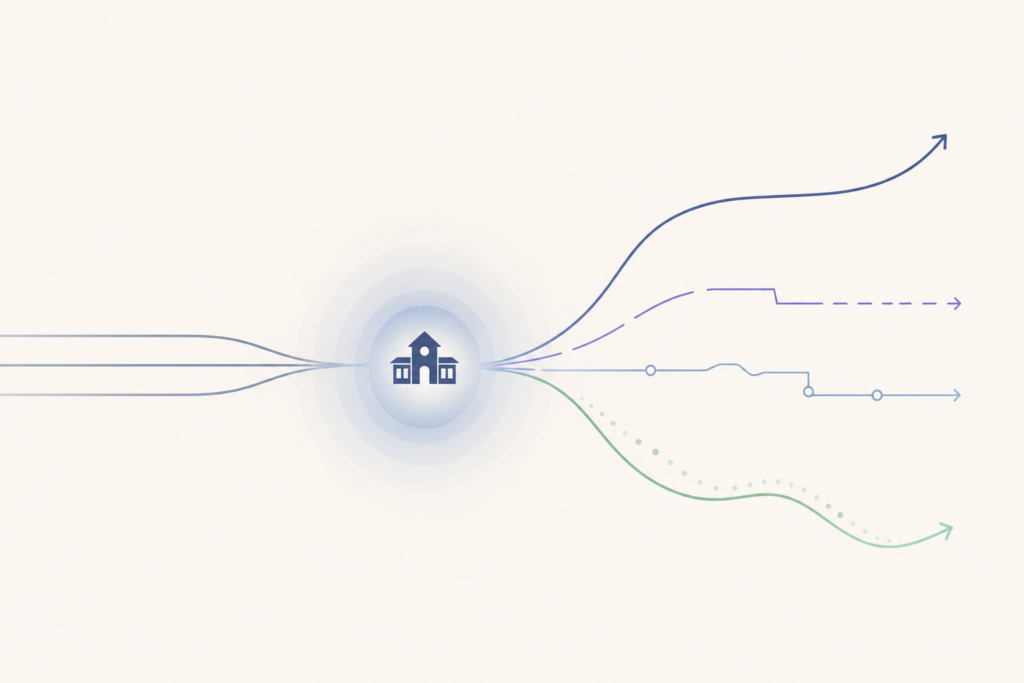
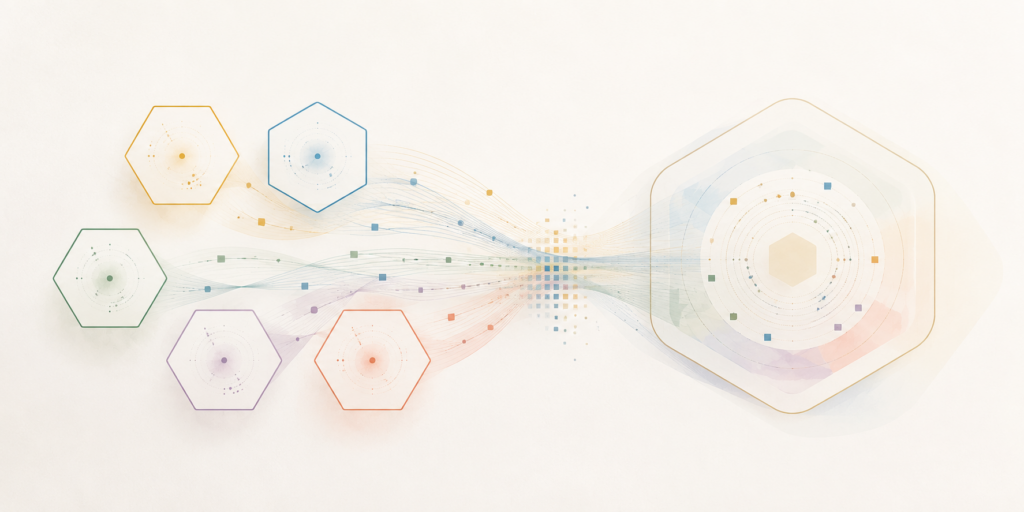
On May 7th, 2026, Olivia Levrini was invited to present the FEDORAS Academy project at the first Annual Meeting of the ISLE Academy project, Collaborative Learning Communities for Redesigning Primary Education: Towards Innovative & Sustainable Learning Environments. The event, titled From Teacher Needs to Systemic Change: Redesigning Innovative Learning Environments, was hosted by INDIRE at the Auditorium Sant’Apollonia in Florence. Her contribution, Navigating Tensions, Enabling Change: Redesigning Science Teacher Education for Futures-Oriented Learning Environments, was part of the session “Inputs from Other Academic Projects.”
FEDORAS warmly thanks the ISLE Academy project and the hosting institution, INDIRE, for the invitation and for creating this space for dialogue among European projects committed to rethinking teacher education, collaborative learning communities, and sustainable learning environments. A special acknowledgment goes to Konstantina Karameri, representing the University of Ioannina, Greece — one of the official partners of the ISLE Academy project — who prepared the questions that guided the presentation. We report here a summary of the answers.
1. To begin, could you briefly explain what “futurizing teacher education” means in practice, especially for science education?
“Futurizing teacher education” does not mean educating teachers for the school of the future. It means infusing teacher education today with content, practices, and tools coming from Futures Studies, in order to help teachers develop, in their students, competences of futures literacy.
I used two keywords here: Futures Studies and futures literacy.
Futures Studies is an interdisciplinary research field that has been developing, mainly since the 1960s and 1970s, many concepts and tools for studying the future. Probably one of the best-known is the Futures Cone, which helps us convey a crucial message: the future is not one but plural. There are possible futures, plausible futures, probable futures, and desirable or preferable futures. This means that futures can be investigated, discussed, imagined, and, to some extent, influenced. Futures Studies has developed techniques to build different types of scenarios and provide consultancy to professionals to make decisions in the present with an eye on a range of possible horizons.
By futures literacy, inspired by the definition provided by UNESCO, we can mean the capacity to use the knowledge and tools developed by Futures Studies to imagine, explore, and deal with possible and alternative futures, in order to act in the present with an eye on the horizon.
Preparing teachers to teach the future does not mean that they have to teach students to predict what will happen, but to anticipate what could happen. To teach students “what if”, in addition to “what is” and “what was”. To teach students to imagine alternatives: many possible, plausible, and desirable futures. To prepare them for multiple contingencies and to think contingently. And, very importantly, to teach students to describe alternative futures and to understand how they can influence them by choosing what they value and using their knowledge, time, and talent to act in the present.
What about these ideas for science teacher education? Futures literacy can be developed through all disciplines. Science, perhaps, bears an enormous responsibility: in the Global North, collective imaginaries of the future remain deeply entangled with an image of futurity forged between the Enlightenment and the twentieth century—one grounded in a deterministic, linear, standardised, and quantifiable conception of time, rooted in the Newtonian-mechanistic view of the world.
The physics of the twentieth century — quantum physics and the physics of complex systems — has expanded models of temporality. The Futures Cone itself is epistemologically grounded in the science of complex systems, and today, many physicists are carrying out research to develop tools to create scenarios. All this is not, typically, part of physics education in schools.
So, futurizing science teacher education, for us, means preparing teachers to value their discipline and subject matter as a way to teach futures: to help students describe alternative futures and feel empowered to influence them through science, imagination, and responsible action.
2. Why is now the moment to rethink teacher education in this way — what pressures or gaps are most urgent?
I think now is the moment because teacher education is under at least two enormous pressures.
The first one is cognitive and psychological. In schools, we increasingly see manifestations of what we could call future anxiety: students often find it difficult not only to choose their future but even to imagine themselves within a future. Developing competences to deal with futures is a way that schools and disciplinary knowledge can support them. Our studies show that introducing the Futures Cone in school also acts at an emotional and psychological level.
The second pressure is social and political. Today, we are all exposed to very powerful and hegemonic images of the future. The dominant iconography of the future is often made of smart cities, skyscrapers, driverless cars, robots, artificial intelligence, space colonies, screens, and technological acceleration. This imagery may look open and innovative, but in fact, it often closes the future. It suggests that the future is already written: technological, urban, fast, hyper-efficient, and largely designed elsewhere.
This appears as a future picture. In fact, our imagination of the future is stuck. We have had the same stereotypical image of the future since the 1970s. This, Futures Studies argues, is the result of a process of de-imaging and defuturizing: it impoverishes imagination and produces presentism. It makes it difficult to imagine alternatives. And this is politically relevant, because controlling the image of the future — exactly as controlling the past — means controlling the present. If only some futures are imaginable, only some forms of action become thinkable.
This is why science education has a specific responsibility here: contributing to enlarging imagination and supporting the new generation to imagine new possible alternatives and become agents of change.
3. You speak about a “language of tensions.” Could you explain it to us and unpack one or two of the most difficult tensions and how they manifest in teacher education?
We introduced the language of tension to express that, in some sense, we are ambitious. For us, futurizing education does not mean simply adding activities about the future to the school status quo. That would be futurewashing: putting the word “future” on practices that remain unchanged.
Futurizing education has a much deeper transformative potential. It should regenerate school knowledge and revalue disciplinary knowledge as a source of competences that help students navigate the complexity of contemporary society and become agents of change for their futures.
But any real transformation introduces noise. It creates disturbance. Futurizing education is disturbing for different reasons: it is interdisciplinary; it expands the temporal frame of schooling; schools usually teach the past — history, consolidated knowledge, established narratives — but rarely teach futures. It also disturbs because it shakes the foundations of scientific school disciplines, like physics, based on the epistemic values of control, determinism, and certainty, by introducing the language of possibility, contingency, and uncertainty within science models. Even if this is the grounding language of contemporary physics, it is still very marginal in school curricula.
So when we speak about a language of tensions, we mean a way to name disturbances produced by a transformative novelty: tensions metaphorically produced when we put something on an elastic carpet. They are signs that something real is happening and that it is changing the “place that we collectively inhabit”. By place, I mean — as Elena Granata says — a space shaped by the knowledge we share, by relations, and by the collective rituals that provide social and cultural meaning to that space.
We like the word tension because it expresses a deformation in the place that can act as a form of vital disorientation: a way to push the school to become a living ecosystem. Not a place where functions, roles, and rituals are fixed and remain the same year after year, but a place where knowledge, relations, and rituals are constantly being redefined.
Tensions are delicate objects. Tensions can be generative because, we think, if no tensions appear, probably no real transformation is taking place. But if tensions become too strong, the relational fabric can break. They require care: epistemic, relational, and institutional care.
Examples of tensions are: at the epistemic level, the will to value science as the ground to develop deep rational and formalized competences and, at the same time, imagination and creativity; at the relational level, the will to value both creative teachers who like to transgress their disciplinary boundaries and teachers who feel more comfortable in their disciplinary competence areas; at the institutional level, the will to create a new flexible temporal mindset in a school organized according to a fixed timetable, or the will to assess both imaginative, open-ended, risky learning processes and the achievement of shared standards.
These tensions are generative: we need to play with them. I cannot imagine a really interesting school where only one pole exists.
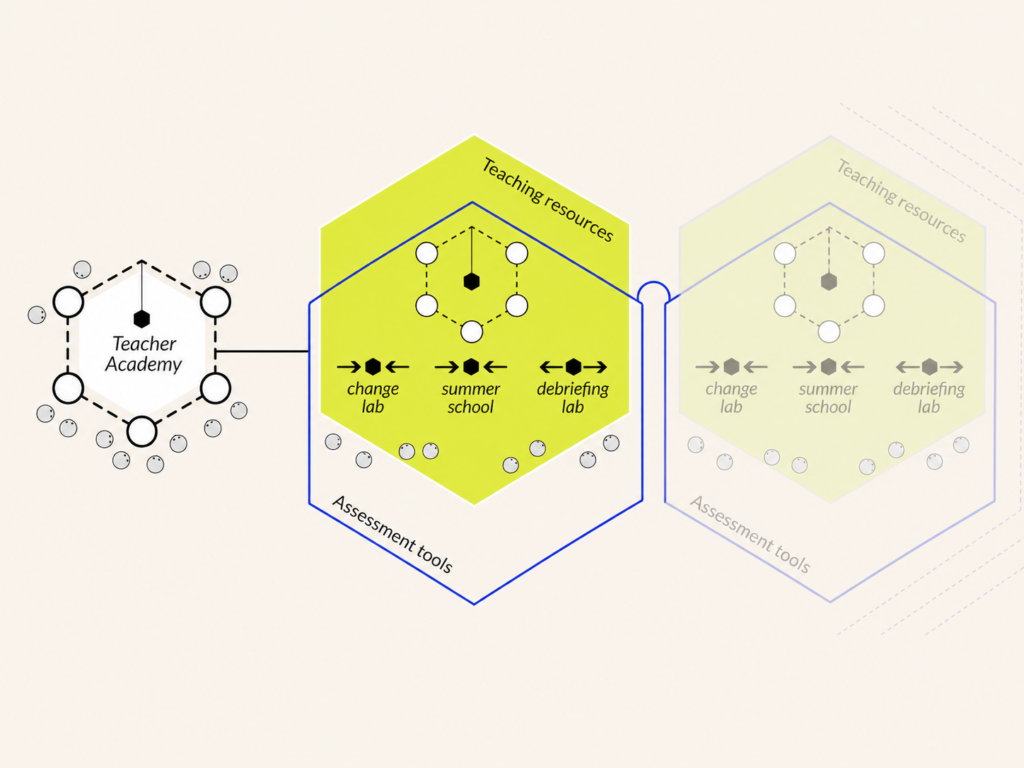
4. Tell us a few words about the FEDORAS Academy project and the uniqueness of the FEDORAS Open Schooling Network model compared to other teacher education approaches. In FEDORAS, we have five National Open Schooling Networks: Finland, Greece, Italy, Norway, and Spain. They have different histories: some were already established in previous projects, especially Greece, Italy, and Norway; others were created within FEDORAS, such as Finland and Spain.
Like most OSNs, they are established as communities of learning where teacher education is supposed to happen within processes of networking, co-learning, co-design, and co-teaching.
Of course, one element of uniqueness concerns the nature of the themes that represent the pillars of what we discuss and implement in the OSNs: futures literacy, interdisciplinarity, and new languages. But also what we call the axes that we use to articulate how these themes can be implemented in school: institutional, relational, and epistemic.
This three-dimensional model comes from the European projects SEAS and CLIMADEMY.
The model is based on the idea that, for us, Open Schooling per se is at least three-dimensional. First, it is institutional: Open Schooling means opening educational spaces and times to local contexts and social dynamics. Second, it is relational: Open Schooling means opening the school to non-traditional actors, competences, and skills, both inside and outside the school, and therefore opening the relations of and among the various actors. Third, it is epistemic: Open Schooling means opening up knowledge itself — opening and transgressing the barriers between disciplines, and between scholastic or academic knowledge and forms of knowledge that are usually not included in school.
This has a great impact on teacher education, since teachers are invited to reflect on their professional profile not only in terms of their positioning with respect to knowledge and students, but also within the relational systems of the school — among colleagues and other stakeholders — and as members of a social and cultural institution.
In FEDORAS, we also have another specificity: a key partner is InfoDesignLab, co-founded by Angela Morelli and Tom Gabriel Johansen. InfoDesignLab is an information design studio that has been collaborating for over 15 years with international scientific organisations such as the IPCC, the European Environment Agency, and the World Meteorological Organisation. Their work focuses on transforming complex data into clear, effective visual and narrative tools to support science communication and policymaking. In our case, they facilitate and support the process and the dynamics within the OSNs by visualising the concepts that we develop.
5. Can you share an example of how school–community relationships are reshaped within this model? I can take the example of the Italian OSN, because it is the one that I know best.
The Italian OSN has a specific tradition. It is rather old, and it is based on two main schools that are also associated partners in FEDORAS: the technical school “Baracca” in Forlì and the scientific lyceum “A. Einstein” in Rimini. Now it also includes the school network of the Licei Matematici in Milan.
What makes this OSN distinctive is, first of all, that we share the idea that innovation should start from disciplines in their form of curricular knowledge, from what is actually taught in schools. The goal is not simply to add activities, projects, or things to do. The goal is to regenerate this knowledge through the three lenses of FEDORAS: futures literacy, interdisciplinarity, and new languages, developing reflection along the three axes that I mentioned before: institutional, relational, and epistemic. Our motto is: regenerating knowledge, changing perspectives, imagining futures within and from the disciplines.
So, our Italian OSN has been built as an interdisciplinary boundary zone, including teachers from all disciplines, principals and vice-principals, researchers in physics education, mathematics education, and science education, scientists, as well as artists and experts in group dynamics and management.
The relationship among these actors is constantly shaped and reshaped through a dynamic of vital disorientation and re-equilibrium. This is also what is allowing the network to grow: in our partner schools, every year, more classes and more teachers become involved. This has been impressive. From very local implementations with a few teachers in their classes, the project became a school project, involving all the teachers of the classes and the vice-principal. Spontaneous WhatsApp groups were created to share ideas, also outside working hours. It started by designating and implementing local activities on the basic concepts of the science of complex systems: irreducibility; multiplicity; circular relationship between the whole and the parts; emergent property: unpredictable, at the level of the constituent elements, collective behaviour, meaning self-organization emerging from microscopic dynamics; need to change the space-time scale in the description of the phenomenon; instability as an opportunity for new ‘robust’ structures to emerge; unpredictability. Then, complexity became a boundary object that allowed teachers from different disciplines (starting with the Italian literature teacher) to share a common language and, then, a common mindset for approaching the school as an ecosystem.
We recently understood that the mechanism of aggregation in the school — the ripple mechanism — was not persuasion, but contagion. People were not persuaded to join because someone explained to them why innovation is important. They were attracted because they recognised a shared vital need: the need to give meaning to staying in school, to find ways to breathe inside the institution, and to infuse new languages and new life into everyday practices.
This became very clear in a recent OSN workshop that we organised with a sociologist, Simonetta Simoni. We realised that we had aggregated around an attitude of appreciative inquiry: not starting from problems or deficits to solve, but, according to the perspective of complexity, a tension toward a view of school to be framed.
So the boundary-zone model has reshaped school–community relationships because it has revealed that we were not aggregated simply to solve problems. We were aggregated to search for new languages to appreciate and give value to the school. And this makes an enormous difference: it unveils and mobilises resources and possibilities, sparks imagination, and opens windows toward new models of school.
6. Assessment is often where innovation struggles — how does FEDORAS approach evaluating learning and professional growth differently? Assessment is very delicate. In FEDORAS, we have been co-designing and implementing materials that are supposed to shake the status quo by regenerating knowledge and developing competences of futures literacy and interdisciplinarity, while introducing new languages.
We are very aware that assessment is often the place where innovation struggles because it tends to bring us back to measurement, control, standardisation, established hierarchies, and fixed roles: those who design assessment, those who perform, and those who are assessed.
In FEDORAS, we try to shift the gaze and re-open the foundational question about assessment. We move from assessment as measurement to assessment as inquiry. This means that assessment is not only a way to check results at the end, but a process of shared exploration. Teachers, students, researchers, and community partners can collectively investigate a shared “theory of value”:
What counts as evidence of meaningful learning?
What values are we recognising — or failing to recognise?
What kinds of learning are becoming visible?
What data do we all produce on learning, on the quality of relations, and on the school as an institution? Is it visible what happens and what makes sense? Are there blind spots?
What rituals are we implicitly activating around assessment? What collective and institutional values do they convey?
We have shared lists of questions to orient our collective practice in Deliverable 4.1. Through these questions, we learn to notice together, where our gaze is oriented along all three axes: the learning processes, but also the relational axis and the institutional quality.
We are at this step of our collective learning on assessment: we have opened our eyes, ears, and bodies to unveil blind spots, ready to be surprised and to collect data that we did not see before.
So, in one sentence, FEDORAS evaluates learning and professional growth by treating assessment not as a final judgement but as a collective inquiry: a way to document, discuss, and value the transformations that innovation produces. We aim to make assessment a practice that gives back the school’s breath, rather than draining its vital spirit.
7. To close the discussion and allow for questions from the audience, what is, in your opinion, the next step that policymakers or institutions could take tomorrow towards futurizing teacher education and allowing for the expansion of sustainable and inclusive school communities?
I think the first step policymakers and institutions could take tomorrow is very simple, but also very radical: let schools live and breathe.
This means putting schools in the conditions to mobilise their own inner resources, giving space to teachers’ creativity, and activating languages of imagination, possibility, and exploration. Futurizing teacher education cannot be reduced to another reform, another protocol, or another checklist. It requires creating the conditions for schools to become communities capable of thinking, experimenting, and imagining.
Recently, in our workshop on appreciative inquiry, we have started to discuss, from a political perspective, about the nature of problems we are addressing, like the one from which we started: how to regenerate knowledge so that it can support students in dealing with future anxiety. They are not simply difficult or complicated problems: they are ontologically complex, wicked problems. They cannot be solved once and for all. They need to be framed, inhabited, and explored. They generate tensions, and we need to learn to dance with these tensions rather than rush to eliminate them. This has a strong implication on our school culture and, if I had to indicate one concrete step, today I would say: policymakers should help make this elephant in the room visible; they should recognise that the problem-solving mindset, while fundamental for addressing complicated problems, is not appropriate for dealing with the complex ones — as Simonetta Simoni helped us to notice – that concern the goal to give value to the school. Complex problems cannot simply be “solved”, they need to be framed so as to allow all of us to learn to “dance with” them, as the GreenComp writes. To deal with them, schools need time, trust, spaces, and languages to name the tensions that are typical of a learning ecology, and to combine the need for safe spaces with the need to play with uncertainty, imagination, and plurality.
In short: do not suffocate schools with innovation. Give them the conditions to breathe, to imagine, and to become sustainable and inclusive communities of futures.
On Tuesday, 7 July 2026, the FEDORAS project held its first symposium, “Regenerating Science Education for a Sustainable World: Interdisciplinarity, New Languages, and Futures Thinking...
From 22 to 26 June 2026, the first FEDORAS Teacher Academy Summer School took place at the University Residential Centre of Bertinoro (CEUB), Italy. The...
On the 10th of July, the Italian Institute for the Future (IIF), one of the leading Italian institutions focusing on futures studies and futures literacy,...
On 28 April 2026, teachers, researchers, school leaders and project partners from FEDORAS and the five Open Schooling Networks gathered for the first International Change...