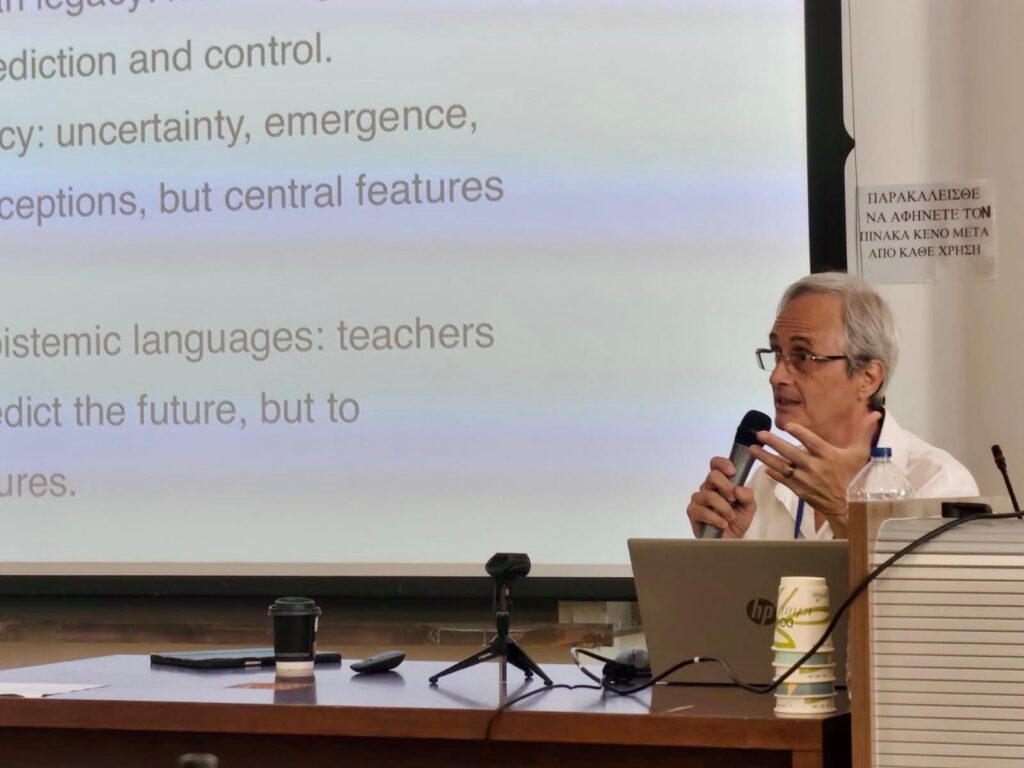
On Tuesday, 7 July 2026, the FEDORAS project held its first symposium, “Regenerating Science Education for a Sustainable World: Interdisciplinarity, New Languages, and Futures Thinking in the FEDORAS Academy,” as part of the GIREP-MPTL 2026 Conference in Rethymno, Crete. The symposium presented four connected studies illustrating how the project’s three central pillars—interdisciplinarity, new languages, and futures thinking—are being developed through teacher education, collaborative design, and classroom practice.
The first contribution presented interdisciplinarity as a form of boundary work, in which disciplinary perspectives, assumptions, and criteria are made visible and open to negotiation. This approach was illustrated through the Deepwater Horizon task, where teachers interpreted satellite images of an oil spill in response to an open question, without a predefined disciplinary pathway or expected answer. It was further explored through the MateMusiFisica experience, a school-based mathematics and physics pathway in which reflective tools were used to document students’ reasoning and emotions when models, expectations, and empirical phenomena did not align.
The second contribution focused on the search for new languages capable of opening disciplinary knowledge to complexity and plural futures. It examined an interdisciplinary co-design process at the “A. Einstein” scientific high school in Rimini, where teachers of physics, philosophy, Italian and English literature, and visual arts explored how concepts from the science of complexity and future studies could circulate across disciplinary boundaries and regenerate curricular content. From this experience, an emerging model of how new languages can be developed in school began to take shape. Calvino’s Invisible Cities created a shared transdisciplinary space in which the “words of complexity” could travel across subjects and be reworked within different disciplinary perspectives. Within this model, the “Story of a Tension” was used as a reflective narrative tool to reconstruct and discuss concrete moments of difficulty, disagreement, or disruption arising during co-design. In this way, it supported the emergence of a shared “grammar of tensions,” through which the epistemic, relational, and institutional dimensions of collaborative work could be made visible and transformed into resources for further development.
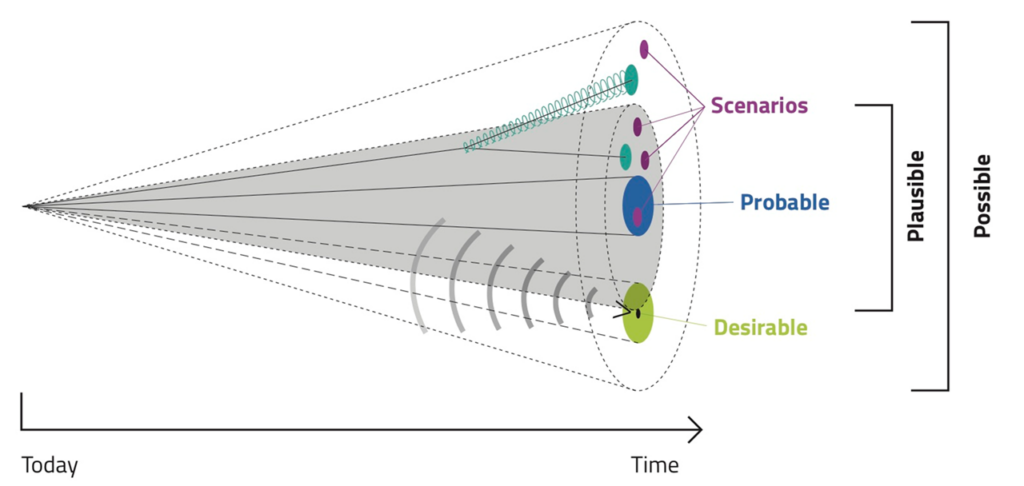
The third contribution examined how twenty-four pre-service teachers translated futures-thinking frameworks into teaching scenarios on climate change. Following a seminar-based course on complexity, uncertainty, the Futures Cone, and alternative future scenarios, they designed materials intended to foster students’ futures thinking. The analysis considered how their scenarios addressed scientific knowledge, the complexity of climate change, temporal perspectives, alternative futures, and opportunities for action. The resulting designs engaged with these dimensions to different degrees, with particularly limited attention to past-oriented reflection, complexity mapping, and meaningful action-taking.
The fourth contribution presented futures-oriented climate-change modules co-designed by secondary-school teachers and researchers and implemented with students in four Cretan schools. The modules invited students to examine climate-related issues across past, present, and future perspectives, to use the Futures Cone to distinguish among possible, plausible, probable, and preferable futures, and to consider actions directed towards preferable outcomes. The classroom experience showed that students could recognise different categories of futures and the influence of present choices, while also revealing difficulties in engaging with complexity, uncertainty, and their own capacity for agency.
Maurício Pietrocola, from the University of São Paulo, joined the symposium as discussant and offered a non-European perspective on the project’s theoretical and methodological foundations. His commentary follows.
Drawing on the contributions presented during the symposium, this commentary offers a broader reading of the theoretical and methodological foundations of the FEDORAS Teacher Academy and situates the project within an ongoing transformation in the cultural role of science education. The commentary focuses on the historical association of science education with certainty, prediction, and progress, and on the capacities needed to engage with futures that are uncertain, negotiated, and collectively shaped.
For a long time, school science has been organised around a powerful epistemological narrative: the idea that science advances by discovering stable laws, reducing uncertainty, and making the future more predictable. This is what I call the Laplacian legacy of science education. In this view, uncertainty appears mainly as a temporary lack of knowledge. With better data, better methods, and better models, uncertainty would progressively disappear.
This narrative has been extraordinarily productive. It supported major scientific and technological achievements and helped establish science as one of the most reliable forms of knowledge. At the same time, it produced a very specific image of science: as prediction, as control, and as the foundation of linear progress.
The first theoretical layer of FEDORAS, as I understand it, is epistemological. FEDORAS questions the persistence of this image in school science. Contemporary science itself has disrupted the Laplacian legacy. Uncertainty, emergence, non-linearity and contingency are not exceptions or failures of knowledge. They are central features of many real-world systems. Climate systems, ecosystems, technological networks, pandemics and social transformations cannot be adequately understood through linear causality alone.
In this sense, FEDORAS responds by creating new epistemic languages. Teachers are invited to use science not only to predict the future, but also to interpret, imagine and navigate open futures.
This leads to a second point: the movement from problems to predicaments.
Traditional science education has often been based on well-defined problems. In a typical school problem, the relevant variables are given, the method is known, and the answer can be validated according to clear criteria. Many contemporary socio-scientific issues do not have this structure. Climate change, biodiversity loss, artificial intelligence, energy transition, pandemics, and environmental degradation are not simply problems with a single correct solution. They are open-ended predicaments.
They combine scientific uncertainty, social values, unequal risks, and unintended consequences. They involve ethical choices, economic interests, political disputes, and institutional constraints. In risk societies, the central educational challenge therefore extends beyond teaching students to solve well-defined problems to preparing them to reason, deliberate, and act in open-ended situations. This does not mean abandoning scientific rigour. On the contrary, it means broadening the scope of science education. Students need scientific knowledge, together with the capacity to evaluate evidence, recognise uncertainty, compare alternatives, anticipate consequences, and reflect on responsibility.
This is where the methodological architecture of FEDORAS becomes especially important.
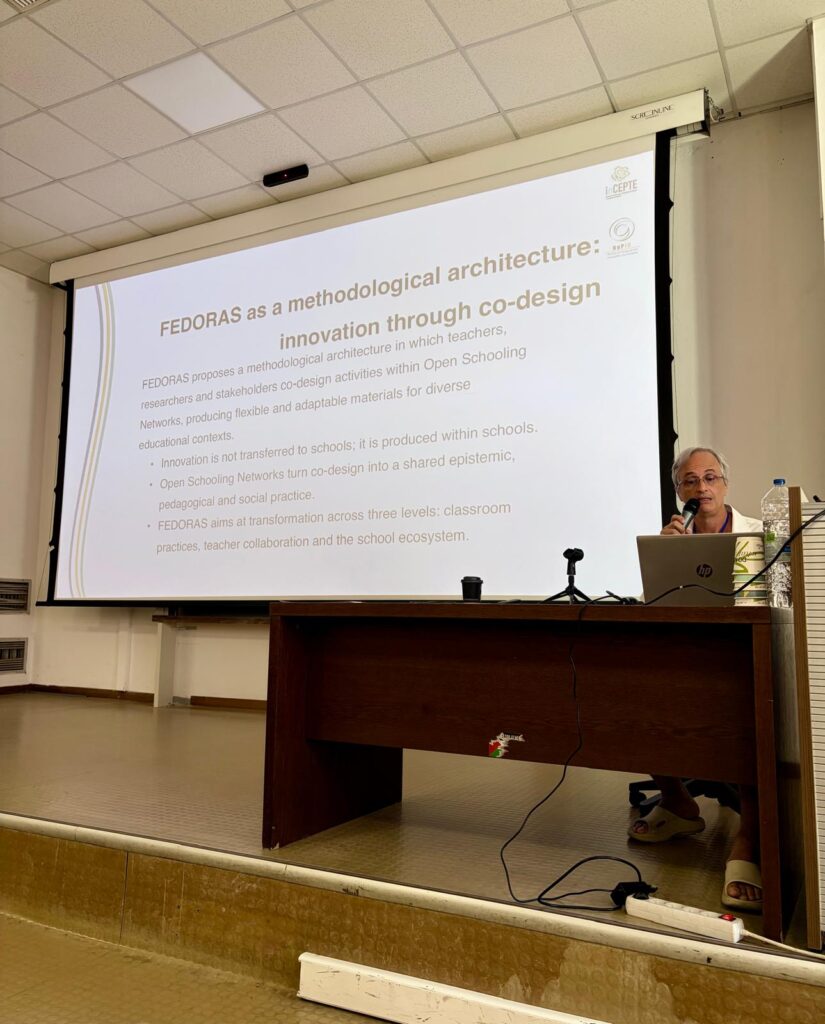
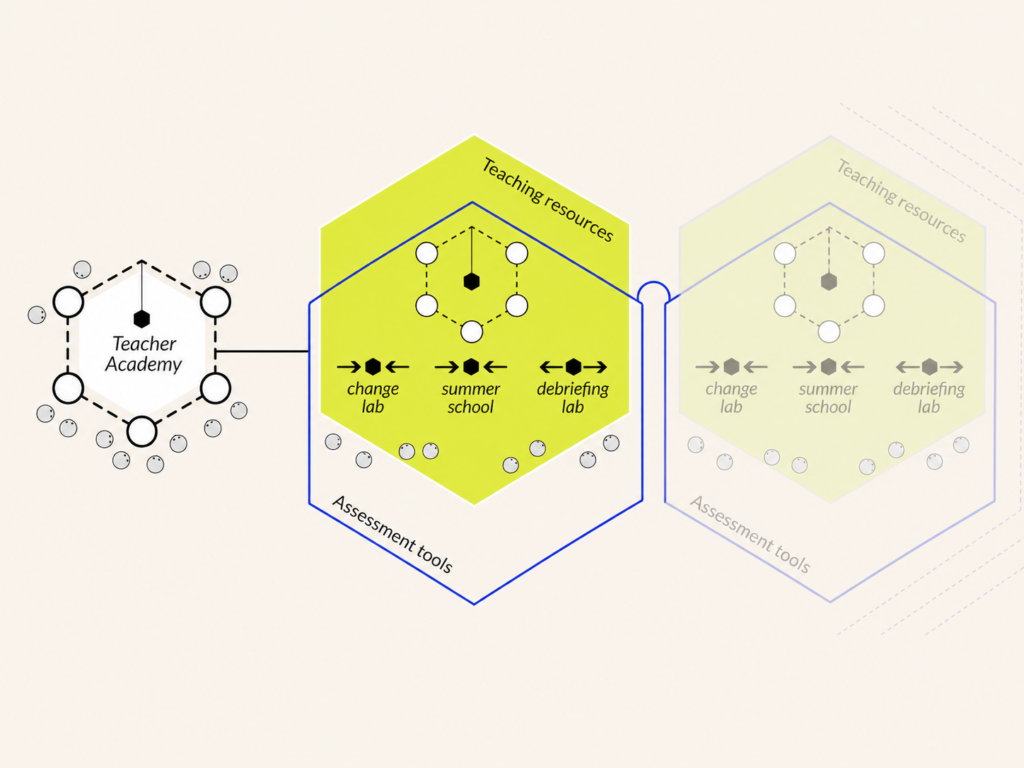
FEDORAS does not treat innovation as a ready-made product to be transferred to schools. It proposes a methodological architecture in which teachers, researchers and stakeholders co-design activities within Open Schooling Networks. These networks create flexible and adaptable materials for diverse educational contexts.
This is a very important point. Innovation is not transferred to schools; it is produced within them. Open Schooling Networks turn co-design into a shared epistemic, pedagogical and social practice. The school is not treated as a passive recipient of external expertise but as a place where scientific, pedagogical, social and institutional forms of knowledge are negotiated and recombined.
FEDORAS seeks transformation at three levels: classroom practices, teacher collaboration, and the school ecosystem. Its ambition extends beyond changing activities to creating the conditions for sustainable educational transformation.
The first pillar of this methodological architecture is interdisciplinarity.
In FEDORAS, interdisciplinarity goes beyond the integration of content or the juxtaposition of physics, mathematics, biology, geography, and the social sciences around a common topic. It is understood as boundary work: a process in which teachers and students become aware of how each discipline frames problems, selects evidence, builds explanations, and defines what counts as a valid answer.
The first presentation, and particularly the Deepwater Horizon task, illustrates this idea clearly. In this task, teachers analyse satellite images of an oil spill and respond to the open question: “What can be said about the oil slick?” Since no disciplinary pathway is provided in advance, they must determine how to frame the problem, what evidence to draw on, and what constitutes an acceptable justification. This “undisciplined” space makes disciplinary assumptions visible. Mathematics may privilege estimation, scale, quantification, or modelling. Physics may focus on motion, causality, and temporal evolution. Other perspectives may introduce ecological, technological, or political dimensions. The task’s educational value lies in making these different ways of framing and interpreting the situation explicit and open to discussion.
In this way, boundary work reframes interdisciplinarity as a formative practice. It helps teachers and students understand both the power and the limits of disciplinary knowledge.
The second major pillar is the search for new languages.
Scientific language is not neutral. It does not merely describe the world. It also shapes what teachers and students are able to see, value and imagine. If science is narrated mainly through prediction, control and linear causality, the future tends to appear closed: either as a continuation of the present or as the result of technical optimisation. Deterministic languages therefore tend to close off the future. They make alternative futures difficult to imagine and suggest that uncertainty is merely a deficit to be eliminated.
By contrast, the language of complexity reopens the future. Concepts such as feedback, emergence, non-linearity, interdependence, contingency and scenario-building offer a different epistemic vocabulary. They help teachers and students think about plural futures, uncertain developments and distributed agency.
In FEDORAS, “new languages” function as epistemic tools rather than merely aesthetic or communicative additions. They enable science education to shift from controlling the future to interpreting, imagining, and navigating open futures.
The Cretan Open Schooling Network offers a strong example of the third pillar: futures thinking. In the presented case, climate change provides the context for helping students move from understanding the present to imagining and acting towards alternative futures. The teaching materials include activities on trends, drivers, uncertainty, students’ views of the future, “what-if” chains, scenario building, the Futures Cone, backcasting and action-taking.
These activities help students understand that the future is not predetermined. It is open, plural and connected to present choices. Through “what-if” chains, students explore how decisions may generate consequences across social and environmental systems. Through the Futures Cone, they learn to distinguish possible, plausible, probable and preferable futures. Through backcasting, they begin to think from a desirable future backwards to the actions that could make it possible.
The Cretan case also reveals an important educational tension. Students can imagine actions, but they do not always see themselves as agents capable of shaping collective futures. They may recognise that the future is open, yet many of their scenarios remain close to current trends or business-as-usual futures. They may propose personal actions, yet still attribute real influence mainly to people in positions of power.
This tension is crucial. Futures thinking encompasses imagination and agency. It asks whether students can see themselves as participants in shaping collective futures
Another important contribution of FEDORAS concerns assessment.
Assessment in FEDORAS extends beyond checking correct answers. In interdisciplinary and futures-oriented contexts, learning cannot be reduced to the accuracy of a final product. What matters is also how students reason, justify, negotiate, deal with incomplete information and recognise the limits of their own models.
The Milan case, particularly the MateMusiFisica pathway, is especially illuminating here. Breakpoints are moments when students encounter mismatches between models, expectations and real phenomena. These moments reveal how students respond when knowledge does not work smoothly. They may feel curiosity, confusion, surprise, frustration, confidence or discouragement.
From a traditional perspective, these tensions might be treated as obstacles. In FEDORAS, they become evidence of learning. Breakpoints, tensions and epistemic emotions show how students engage with disciplinary limits and the uncertainty inherent in real phenomena.
Assessment therefore becomes formative. It makes uncertainty, disagreement, and disciplinary limits visible and open to discussion. It becomes a means of measuring learning and of supporting epistemic awareness, authentic participation, and reflection.
Having highlighted the relevance and novelty of FEDORAS, I now turn to its transferability from a non-European perspective, particularly one grounded in Brazil and Latin America.
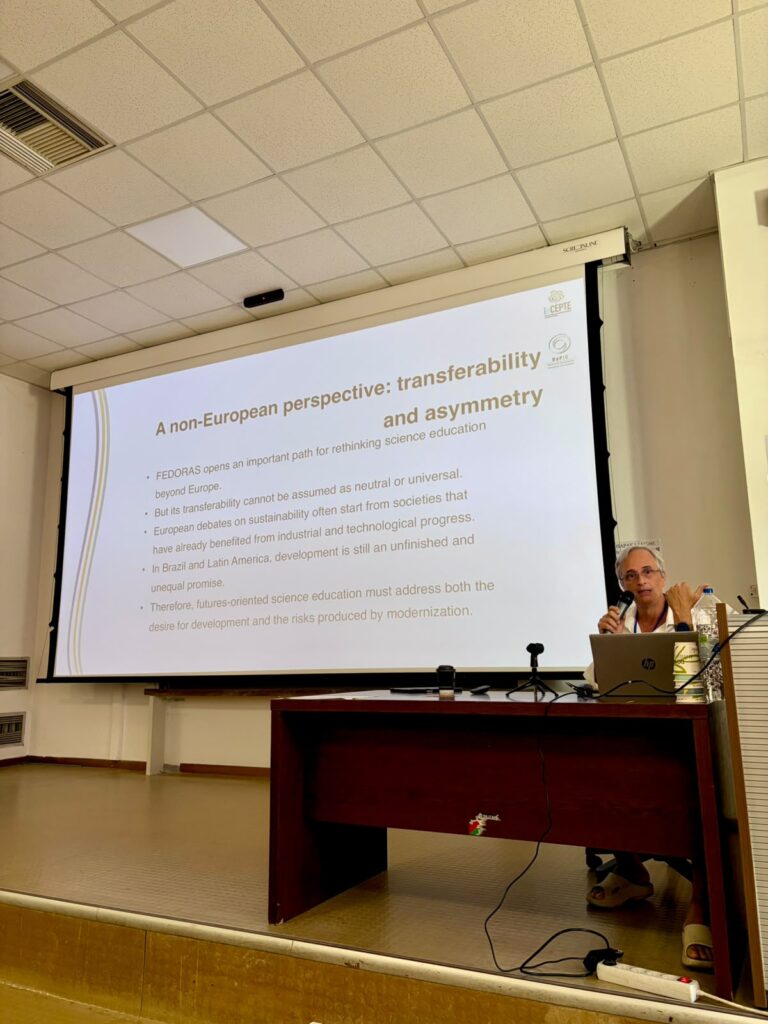
FEDORAS opens an important path for rethinking science education beyond Europe. Its transferability, however, cannot be assumed to be neutral or universal. European debates on sustainability often begin with societies that have already benefited from industrial and technological progress. In Brazil and Latin America, material development remains an unfinished and unequal promise.
This creates a distinct educational and political context. Futures-oriented science education must address both the desire for development alongside the risks produced by modernisation. It must recognise that many populations still expect access to the benefits of modernity, while at the same time living with the environmental and social consequences of modernisation itself, produced locally and globally.
This context makes the question of how to decolonise the future especially important.
In Latin America, the future has been colonised materially, politically, ecologically, and epistemologically. Coloniality concerns whose knowledge counts, as well as land, extraction, dependency, inequality, violence, and socio-environmental destruction.
The central questions are therefore: whose knowledge counts, and whose futures are made possible, delayed, sacrificed, or made impossible?
Decolonising futures-oriented science education means reinterpreting FEDORAS through histories of coloniality, extractivism, inequality, and unfinished development. It means recognising the multiple dimensions of these tensions: epistemic, political, economic, ecological, cultural, and institutional.
From a Latin American perspective, futures thinking cannot be merely an exercise in imagination. It must also be an exercise in redirecting inherited trajectories of inequality, dependency and socio-environmental destruction.
This need for contextual reinterpretation reveals the potential of FEDORAS. Its transferability depends on its capacity to be reworked in relation to different histories, risks, and possibilities. FEDORAS could therefore function as a flexible framework rather than as a universal recipe.
One of the most significant contributions of FEDORAS may lie in the cultivation of epistemic humility.
FEDORAS strengthens science education by moving beyond the idea of science as a source of complete certainty and control. Science remains a powerful means of producing reliable knowledge; decisions concerning social, political, and ethical futures also involve values, choices, conflicts, and forms of collective responsibility that cannot be determined by scientific knowledge alone.
Epistemic humility entails confidence in science alongside an awareness of its limits. Scientific inquiry is guided by objectivity and rigour, while the knowledge it produces remains situated, revisable, and incomplete when applied to complex socio-scientific issues. Climate change, sustainability, artificial intelligence, and environmental risks require scientific understanding while also involving values, choices, conflicts, and responsibilities.
Science education should therefore prepare students to combine evidence, judgement, imagination, and collective responsibility when navigating uncertain futures.
From this perspective, FEDORAS can be understood as a laboratory for rethinking the cultural role of science education in uncertain times. Its theoretical strength lies in challenging the deterministic legacy of school science. Its methodological strength lies in creating spaces where teachers, students, and communities can co-design ways to navigate uncertainty. Its main challenge, especially from a non-European perspective, is to keep futures-oriented science education sensitive to the unequal histories, risks, and possibilities that shape different societies.
Mauricio Pietrocola
School of Education – University of São Paulo
Comments about FEDORAS coordinated session- GIREP 2026