On the 10th of July, the Italian Institute for the Future (IIF), one of the leading Italian institutions focusing on futures studies and futures literacy, published a policy brief named “Exploring possible futures for the schools of 2050”. The policy brief is the result of an interdisciplinary collaboration between 2 authors:
Lorenzo Miani, a Postdoc researcher in Physics Education at the University of Bologna with an active role in the Fedoras project, whose research focuses on climate change, uncertainty and futures-oriented science education
Federica Moscatelli, a teacher of Spanish with a PhD in Languages, cultures and modern literature, whose work focuses on eco-dystopias in Hispano-American literature and on the role of imagination and narratives in shaping alternative futures.
The policy brief is the result of an award won by the authors at the last IIF conference held in Naples in September 2025, namely the Under-35 best presentation award. The award has been shared with two other colleagues, Roberto Cirillo (University of Campania, Future scenarios in the automotive industry: predictive algorithms and strategic trajectories) and Angela Faiella (University of Bologna, Biases and Heuristics in Future Thinking: Recognising Them and Exploring Them with the Archetypes Cards). Each winner has been asked to produce a policy brief to be published by the IIF.
The policy brief
The policy brief explores how education influences society and vice versa, emphasising the role of futures thinking in envisioning, modelling, and transforming the function of schools. As educational systems face growing demands to address climate change, rapid technological progress, social inequalities, democratic vulnerabilities, and uncertainty, schools do more than just prepare students to adapt to these changes: they actively influence how young people conceive of possible, desirable, and meaningful futures.
As reported in the Executive summary, the brief’s central claim is that futures literacy should become a core educational competence, developed through interdisciplinary practices that connect science, literature, sustainability, and collective imagination. Science education can help students engage with complexity, uncertainty, systems thinking, and the socio-ethical implications of technological change. Literature and narrative practices can expand the range of futures students can imagine, question deterministic or catastrophic narratives, and support ethical and political reflection. Together, these domains can help education move beyond adaptation and become a space for collective agency.
The brief develops this argument in four steps:
it frames the educational challenge of the Anthropocene, drawing attention to the risks of instrumentalising education around growth, productivity, and technocratic adaptation.
it reviews key frameworks and trends shaping futures-oriented education, including GreenComp, international debates on futures literacy, the role of AI and techno-solutionism, and emerging research on futures thinking in science education.
it presents three examples of initiatives working at the intersection of education, science, literature, and futures thinking: Teach the Future, FEDORA/FEDORAS, and CoFutures.
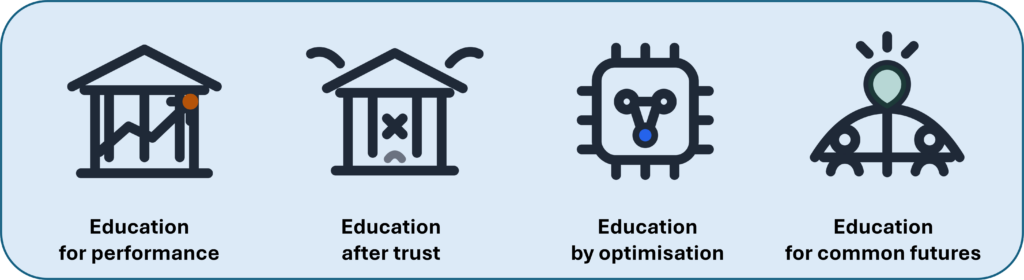
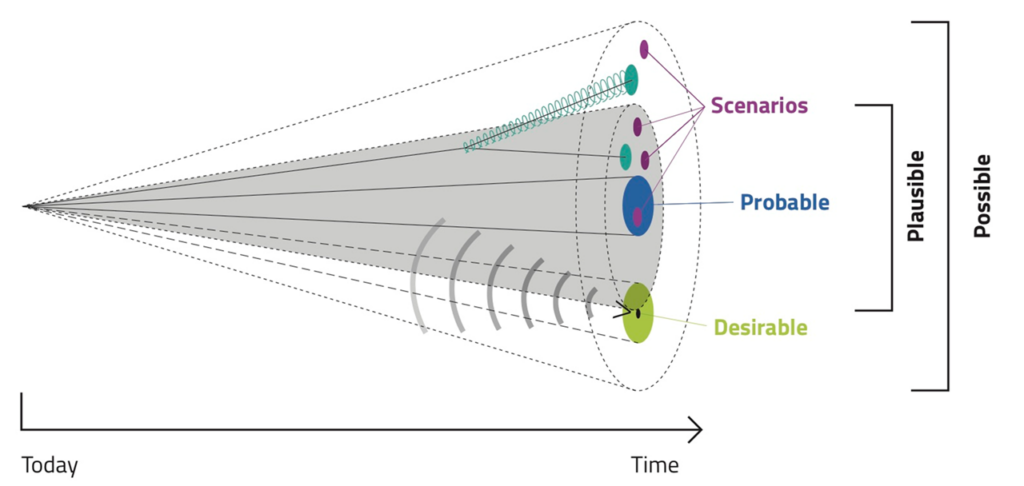
it develops four scenarios for the school of 2050 using Dator’s Four Futures and the Three Horizons framework: Education for Performance, Education after Trust, Education by Optimisation, and Education for Common Futures.
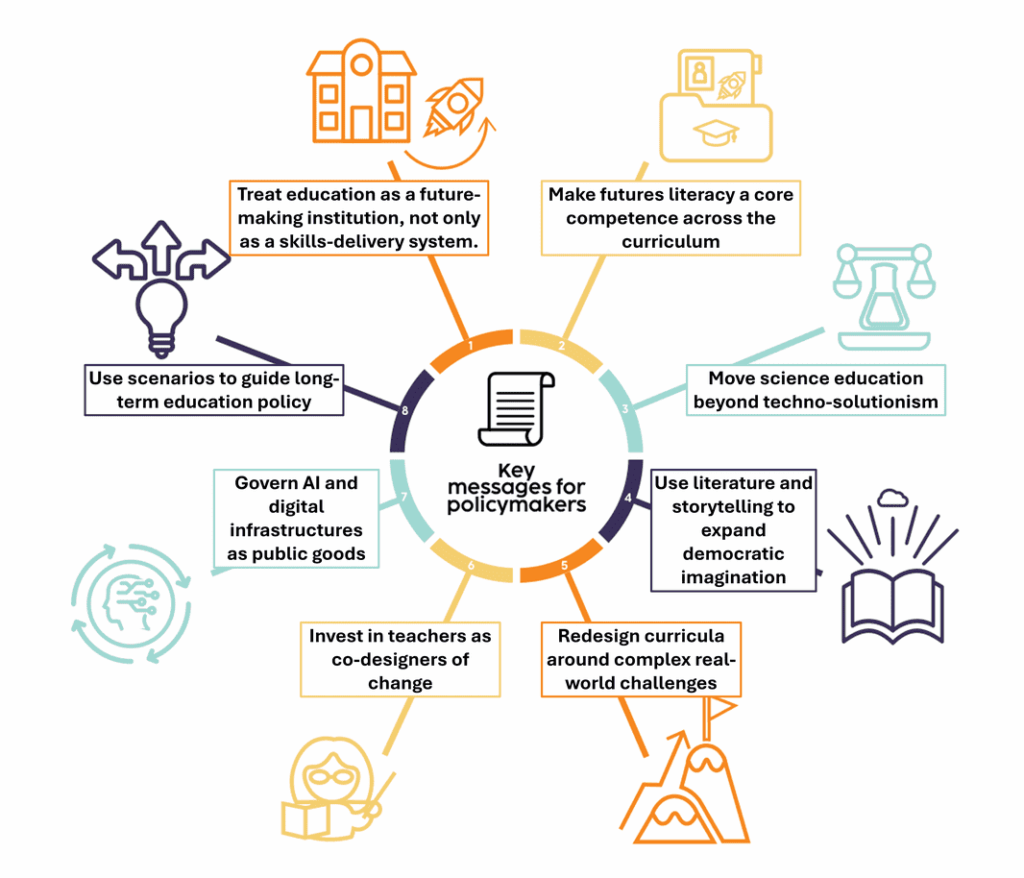
The brief concludes with eight policy messages addressed to schools, local governments, and state/national policymakers. These messages call for futures literacy across curricula, stronger interdisciplinary teaching, teacher agency, public governance of AI infrastructures, and the use of scenario-based thinking to guide long-term education policy. The overarching recommendation is clear: education policy should not only ask how schools can adapt to the future, but what kinds of futures schools should help create.
4 scenarios for the school of 2050
The most original part of the brief is the presentation of 4 scenarios for the schools of 2050, designed starting from the 4 archetypical futures of Jim Dator and the Three Horizons model of Sharpe.
The scenarios are presented in 3 forms:
an analytical discussion based on 6 descriptors: societal logic, purpose of education, curriculum and knowledge, governance and organisation, relationship with society, and risks and policy dilemmas
a narrative, in which we describe a possible day in the school of 2050 for each scenario
an evocative piece, connected to the narrative, where the same type of scenario is presented from a third-point perspective.
The four scenarios are:
Education for Performance: school as a space of power, productivity and institutional alignment
Education after Trust: school as an exhausted institution that no longer speaks to younger generations
Education by Optimisation: school as a data-driven, AI-mediated and hyper-personalised learning ecosystem
Education for Common Futures: school as a civic, ecological and imaginative infrastructure
The transformative potential of FEDORAS
As described before, the FEDORAS project is presented as a living example for futures-oriented practices for education. The brief introduces FEDORAS as the continuation of FEDORA (Future-Oriented Science Education to Enhance Responsibility and Agency), the Horizon 2020 project aiming to regenerate science education by working on interdisciplinarity, futures thinking and new languages for science education (Levrini et al., 2019; 2021).
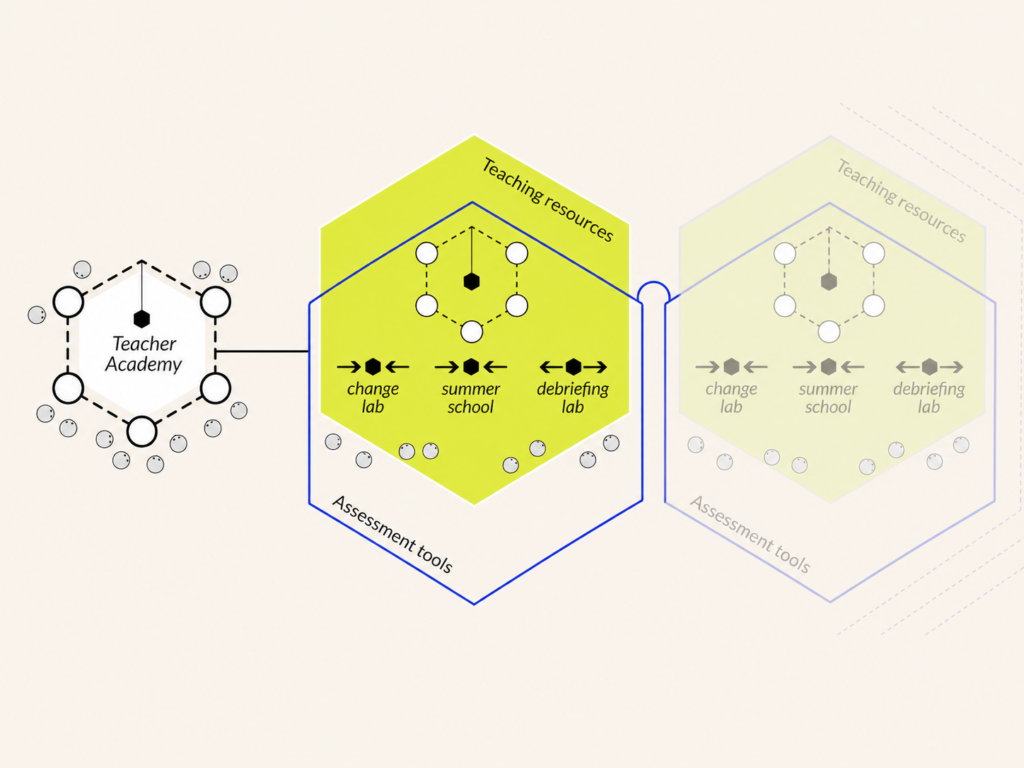
The brief presents the main aspects of the FEDORAS Teacher Academy: open schooling environments, the application of futures thinking to introduce a temporal dimension to learning, and the need to open science education practices to other fields of knowledge to address uncertainty, complexity, and value-based decisions, underlining also the fact that in FEDORAS teachers are positioned as co-designers of innovation.
The brief then presents the key message for policymakers emerging from FEDORAS, i.e. futures literacy should be supported through systemic conditions: interdisciplinary curricula, teacher professional development, open schooling networks and institutional spaces where schools, researchers and communities can co-design educational innovation.
On Tuesday, 7 July 2026, the FEDORAS project held its first symposium, “Regenerating Science Education for a Sustainable World: Interdisciplinarity, New Languages, and Futures Thinking...
From 22 to 26 June 2026, the first FEDORAS Teacher Academy Summer School took place at the University Residential Centre of Bertinoro (CEUB), Italy. The...
On 28 April 2026, teachers, researchers, school leaders and project partners from FEDORAS and the five Open Schooling Networks gathered for the first International Change...
08.05.2026
AUTHOR: Olivia Levrini Professor in Physics Education and History of Physics, University of Bologna
On May 7th, 2026, Olivia Levrini was invited to present the FEDORAS Academy project at the first Annual Meeting of the ISLE Academy project, Collaborative...