About the project
The FEDORAS Academy builds on decades of educational research and policy work to respond to one urgent question: How can teacher education better prepare young people for the complex, interconnected futures they are entering?
Today’s education systems face deep challenges. There is a growing misalignment between what schools are designed to do and the realities young people are living through: climate breakdown, digital transformation, democratic backsliding, and new forms of inequality and disconnection.
The FEDORAS Academy is a three-year initiative co-funded by the European Union to regenerate teacher education in response to these realities. It aims to support secondary school teachers by creating dynamic, research-informed, and community-connected learning environments across Europe.
…
The foundations
The FEDORAS Academy is not starting from scratch. It builds directly on the insights, methods, and findings of previous European projects, including:
- FEDORA (Future-oriented Education and Democratic Resilience)
- SEAS (Science Education for Action and Engagement towards Sustainability)
- CLIMADEMY (Climate Change, Education, and Democracy)
- I SEE and IDENTITIES, which explored imagination and identity in science education
These projects highlighted the need to go beyond siloed knowledge and create interdisciplinary, future-oriented, and imaginative spaces for learning.
FEDORAS takes these insights further by focusing on systemic change in teacher education, and by embedding its work in real school communities.
Promoting future-oriented teaching through open and inclusive learning environments. FEDORAS Academy, Open Schooling Network
Students exploring sustainability challenges through hands-on collaboration. Open Schooling activity, FEDORAS Academy
The challenge
Across Europe, education systems are under pressure from multiple directions:
- Teachers report burnout, isolation, and a lack of relevant training for today’s challenges
- Students face anxiety about the future and feel disengaged from what they learn
- Schools are often disconnected from local communities and broader societal shifts
The Academy recognises that a regenerative approach to education is needed one that is collaborative, contextual, and capable of responding to complexity.
This work aligns with the European Commission’s GreenComp (European sustainability competence framework) and the Council Recommendations on key competences for lifelong learning.
…
The Approach
The FEDORAS Academy works through a research-based, participatory model of transformation. Its core strategies include:
- Co-design: Bringing together teachers, researchers, and communities to develop context-specific educational practices
- Open Schooling Networks (OSNs): Five regional clusters in different countries where innovation is tested, refined, and shared
- ChangeLabs: Local action spaces for experimenting with new practices
- Mobility and exchange: Structured opportunities for educators to share, reflect, and grow across contexts
- Innovative assessment: Tools that track and support deep learning, collaboration, and institutional change
The project follows a design-based research methodology with iterative cycles of action, reflection, and redesign. It draws on boundary-crossing theory (Akkerman & Bakker, 2011) to support interdisciplinary learning across domains and stakeholder groups.
…
The Project Structure
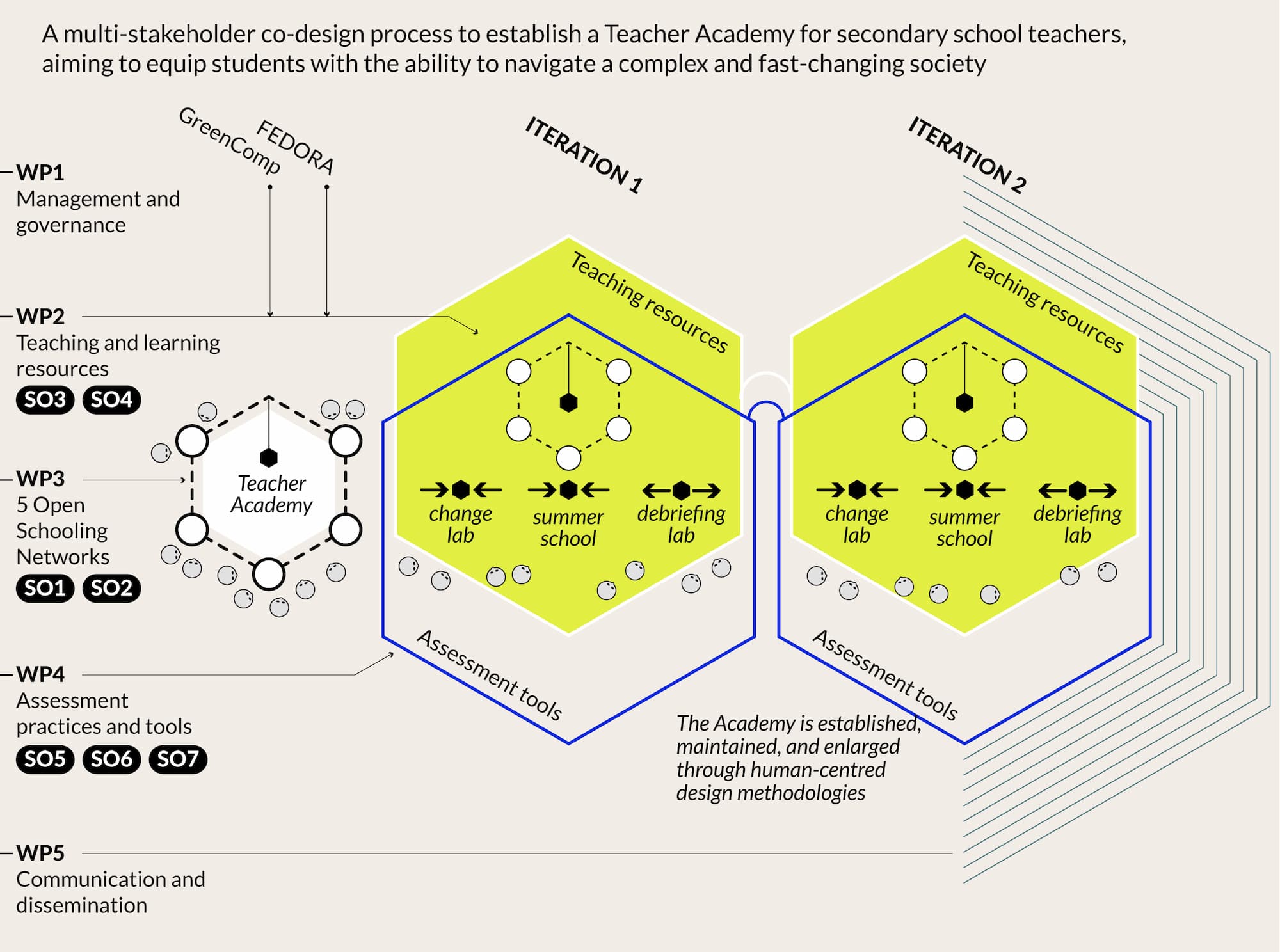
FEDORAS is organised across five Work Packages (WPs), each with a dedicated focus:
- WP1: Management – Coordinating activities across countries and institutions
- WP2: Teaching and learning resources – Co-developing and testing educational tools
- WP3: Open Schooling Networks and ChangeLabs – Supporting local engagement and institutional innovation
- WP4: Assessment practices and tools – Researching and designing new ways to assess transformative learning
- WP5: Communication and Dissemination – Sharing insights, resources, and stories with broader audiences
The project structure and how the Specific Objectives (SOs) are related to the Work Packages (WPs)
…
Core Partners
The FEDORAS Academy brings together leading institutions in science education, teacher training, and design for learning from across Europe. It includes partners in Greek, Finland, Italy, Norway and Spain, each contributing specific expertise and local networks.
- University of Bologna (UNIBO) – Italy
- University of Oslo (UiO) – Norway
- University of Helsinki (UH) – Finland
- University of Girona (UdG) – Spain
- University of Crete (UoC) – Greece
- InfoDesignLab (IDL) – Norway
- University of Milan (UMIL) – Italy
- Kaunas University of Technology (KTU) – Lithuania
- Blindern School (BS) – Norway
Associated Partners
These institutions are officially supporting the project but are not full consortium members:
- IIS Baracca – Forlì, Italy
- Liceo Einstein – Rimini, Italy
- Institut de Celrà – Girona, Spain
- Helsinki Normal Lyceum – Part of University of Helsinki
Advisory Board Members
Contributing with strategic insights and policy expertise:
- Dr. Stefania Bocconi – CNR, Italy
- Dr. Erica Bol – JRC, EU Commission
- Prof. Sibel Erduran – University of Oxford (implied from context)
References and Background
- Akkerman, S.F., & Bakker, A. (2011). Boundary crossing and boundary objects. Review of Educational Research, 81(2), 132–169.
- European Commission (2022). GreenComp: The European sustainability competence framework.
- Council of the EU (2018). Recommendation on Key Competences for Lifelong Learning.
- FEDORA Project → [https://www.fedora-project.eu]
- SEAS Project → [https://www.seas.uio.no]
- CLIMADEMY Project →[ https://climademy.eu/]
- IDENTITIES →[https://identitiesproject.eu/]
- I SEE → [https://iseeproject.eu/]
Who we are
Core Partners
University of Bologna (UNIBO)
Olivia Levrini
Full Professor in Physics Education and History of Physics, Department of Physics and Astronomy “A. Righi”
Giulia Tasquier
Associate Professor in Physics Education and History of Physics, Department of Physics and Astronomy “A. Righi”
Sara Satanassi
Post-Doc in Physics Education and History of Physics, Department of Physics and Astronomy “A. Righi”
Lorenzo Miani
Post-Doc in Physics Education and History of Physics, Department of Physics and Astronomy “A. Righi”
Saul Casalone
PhD in Physics Education and History of Physics, Department of Physics and Astronomy “A. Righi”
Francesca Riccioni
PhD in Physics Education and History of Physics, Department of Physics and Astronomy “A. Righi”
University of Oslo (UiO)
Erik Knain
Full professor in Science Education, Department of Teacher Education and School Research
Jelena Radišić
Researcher, Department of Teacher Education and School Research
Mari Heum Sjøberg
Postdoctor, Science Education, Department of Teacher Education and School Research
University of Helsinki (UH)
Antti Laherto
Associate Professor in Science Education, Department of Education
Tapio Rasa
Postdoctoral Researcher in Educational Sciences, Department of Education
Sara Komulainen
Doctoral Researcher in Educational Sciences, Department of Education
University of Girona (UdG)
Alfredo Jornet Ramón y Cajal
Researcher at the Department of Psychology, Faculty of Education and Psychology
Raquel Heras
Associate Professor at the Department of Specific Didactics, Educational Research Institute
Ingrid Mulà
PhD in Sustainability, Department of Specific Didactics, Educational Research Institute
Moisès Esteban
Professor at the Department of Psychology, Faculty of Education and Psychology
University of Crete (UoC)
Dimitris Stavrou
Full Professor in Science Education, Department of Primary Education
Emily Michailidi
Assistant Professor in Teaching of STEM Subjects in Primary Education, Department of Primary Education, University of Crete
Athanasia Kokolaki
Post-Doc in Science Education, Department of Primary Education, University of Crete
Argyris Nipyrakis
Post-Doc in Science Education, Department of Primary Education, University of Crete
Giorgos Peikos
Post-Doc in Science Education, Department of Primary Education, University of Crete
Chara Bitsaki
PhD in Science Education, Department of Primary Education, University of Crete
Nikos Kapelonis
PhD in Science Education, Department of Primary Education, University of Crete
InfoDesignLab (IDL)
Angela Morelli
Tom Gabriel Johansen
University of Milan (UMIL)
Laura Branchetti
Associate Professor in Mathematics Education, Department of Mathematics “F. Enriques”
Miglena Asenova
Associate Professor in Mathematics Education, Department of Mathematics “F. Enriques”
Violetta Lonati
Researcher in Computer Science Education, Department of Computer Science “G. Degli Antoni”
Luca Lamanna
Researcher in Computer Science Education and Mathematics Education, Department of Computer Science “G. Degli Antoni”
Sara Gagliani Caputo
Researcher in Mathematics Education, Department of Mathematics “F. Enriques”
Lorenzo Pollani
Researcher in Mathematics Education, Sapienza University of Rome, Department of Mathematics “G. Castelnuovo”
Kaunas University of Technology (KTU)
Raminta Pučėtaitė
Full Professor and principal investigator of Public Governance group at the Faculty of Social Sciences, Arts and Humanities
Donata Jovarauskienė
Assistant professor and a member of the Public Governance research group
Laura Daniusevičiūtė-Brazaitė
Associate professor in educational sciences with specialization in neurosciences
Jolanta Vaičiūnienė
Head of Municipal Training Centre
Blindern School (BS)
Tonje Røseth
Assistant Principal
Helle Bjørsom
Head Science Department
Trym Kasper Ekhaugen
Science Teacher
Associated Partners
Christian Morellini
Local coordinator and member of the team of the Italian Open-Schooling Network
Barbara Teodorani
Member of the team of the Italian Open-Schooling Network
Michela Clementi
Local coordinator and member of the team of the Italian Open-Schooling Network
Paola Fantini
Member of the team of the Italian Open-Schooling Network
Daniela Trausi
Member of the team of the Italian Open-Schooling Network
Sara Moresco
Member of the team of the Italian Open-Schooling Network
Luciana Morri
Member of the team of the Italian Open-Schooling Network
Tapio Lahtero
Administrative Principal, Local Coordinator, Member of the Finnish Open-Schooling Network