The Italian National Change Lab was conceived as a moment of encounter between two Open Schooling Networks, each grounded in a distinct research culture and developed through long-term collaborations between universities and schools.
The first of these networks is the Open Schooling Network coordinated by the University of Milan. It emerges from a long-standing research trajectory in mathematics education, particularly concerned with the dialogue between mathematics and physics and with inquiry-oriented approaches to teaching and learning. Over time, this work has developed through sustained collaboration with upper secondary schools, most notably within the LiceoMatematico initiative, where these research perspectives are explored and reinterpreted in classroom practice. Within this collaboration, particular attention is given to the Laboratorio di matematica, where students engage in exploration, modelling, and collective mathematical discussion, approaching mathematics not only as a formal discipline but also as a cultural practice and a specific form of rational inquiry. These activities are often developed through interdisciplinary collaboration among teachers from different subjects and are connected to broader societal questions and to students’ orientation toward university studies.
Teacher professional development represents a key dimension of this trajectory. Through seminars, workshops, and ongoing exchanges between teachers and researchers, the network creates opportunities for collective reflection on classroom practices and for the collaborative design and experimentation of new learning activities.
The second Open Schooling Network is centered in two Associated Partners of FEDORAS: the Scientific Lyceum ‘Einstein’ and the aeronautical technical school ‘Baracca’. The OSN is coordinated by the University of Bologna and evolved across the projects I SEE, IDENTITIES, FEDORA, SEAS, and CLIMADEMY. Through this long-term collaboration, a stable network of researchers and teachers emerged, working together to explore how school knowledge can engage with contemporary societal challenges.
The Scientific Lyceum Einstein became involved in this trajectory during the I SEE project, contributing to the development and implementation of STEM and future-oriented modules on emerging topics such as artificial intelligence and quantum technologies. The aeronautical technical school Baracca joined the collaboration later, drawn by this future-oriented approach and by the opportunity to connect technical education with broader reflections on societal transformations. As new projects followed, the collaboration between the research group and the two schools expanded within the school communities. Initially, only a small number of teachers were involved. Over time, through cycles of implementation and reflection, teachers found ways to reinterpret the ideas and reflections emerging from the European projects within their own school contexts. The collaboration thus developed as a reciprocal process: ideas, perspectives, and ways of thinking circulating within the European projects were interpreted and adapted within school contexts, while the experiences emerging from the schools fed back into the projects, contributing new perspectives and meaningful experiences. Within this process, three pillars of FEDORAS gradually became central to the work carried out in the schools: interdisciplinarity, new languages, and futures thinking. Interdisciplinarity developed through dialogue between science and mathematics and the humanities and social sciences, including literature, history, philosophy, art, and English. The exploration of new languages emerged through diverse expressive forms, such as artistic practices, storytelling, music, and other creative approaches, to construct new narratives around complex contemporary issues, such as artificial intelligence and climate change. Futures thinking was fostered by engaging students with questions about uncertainty, technological change, and the role of scientific knowledge in imagining and navigating future scenarios.
This process also reshaped both the socio-relational dynamics among teachers and the institutional conditions through which these interdisciplinary projects were developed within the schools. At the socio-relational level, the work of the three themes fostered new forms of collaboration among teachers from different disciplinary backgrounds. Science and mathematics teachers began working together with colleagues from the social sciences and humanities to co-design interdisciplinary projects and bring different forms of expertise into dialogue. In this collaboration, the projects’ themes were interpreted and developed in ways that made sense within the teachers’ own school contexts. At the institutional level, these initiatives gradually became embedded within existing school structures. Projects developed in collaboration with the university began to be discussed and approved within class councils and were progressively integrated into the schools’ curricular planning.
Within FEDORAS, the Bologna network builds on a long-standing collaboration between the research group and the two schools. At the same time, the project has brought new schools into the network, such as those in Milan.
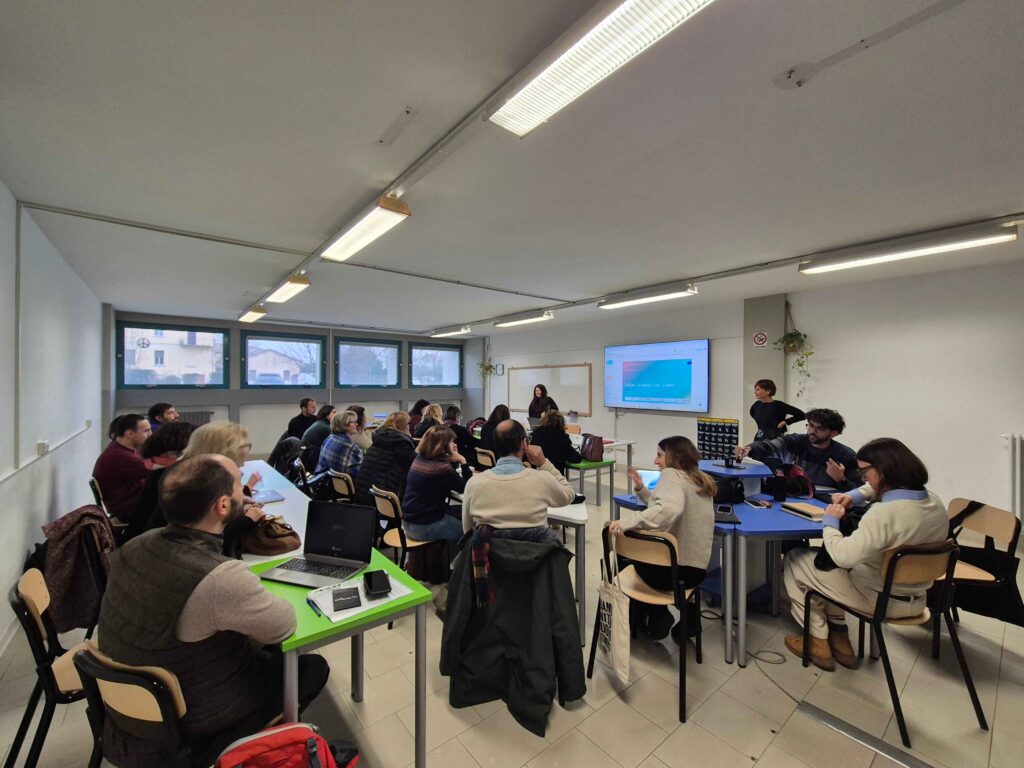
The National Change Lab held on February 19 was centred on the sharing of two different experiences.
After a brief introduction by the Milan research team, a teacher from one of the participating schools outlined how the Liceo Matematico initiative had progressively developed across different schools. In her account, the exchanges that initially connected a small group of schools gradually evolved into a local network, which later expanded to include additional institutions. Over time, the initiative became part of a broader national coordination among Licei Matematici affiliated with different universities, supported by a technical–scientific committee. This trajectory has recently entered a new phase, as the national network has begun a process of formal recognition within the Italian educational system, with a request submitted to the Ministry of Education to recognize the LiceoMatematico as a curricular initiative and to initiate ministerial evaluation. Through her narrative, the Milan experience emerged as an example of how sustained collaboration between researchers and teachers can progressively develop a broader organisational structure that links schools, professional communities, and national educational policy.
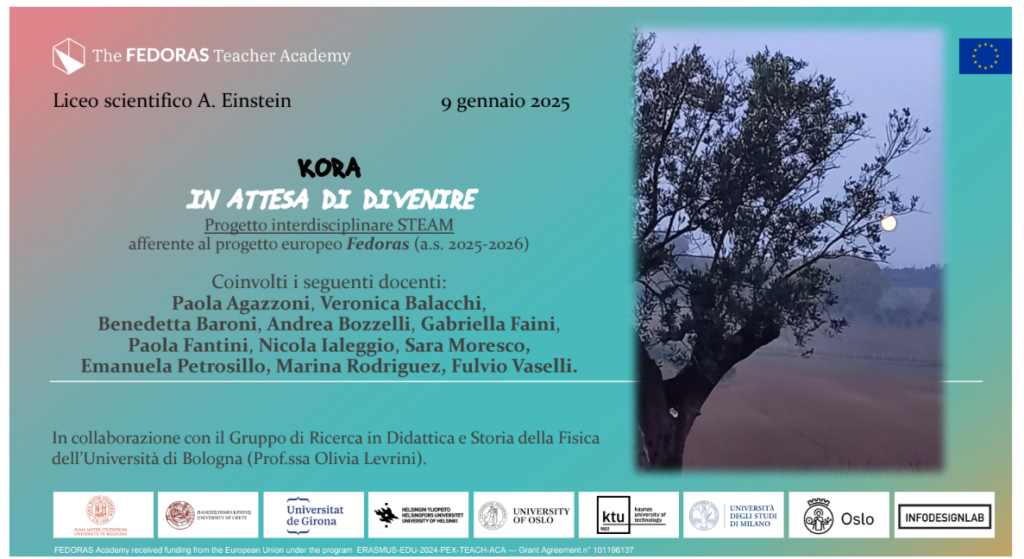
The stage was then left to the associated schools. The trajectory presented by the Liceo Einstein in Rimini illustrated this process in detail. Over the years, teachers developed a series of projects on topics such as complex systems, time, uncertainty, artificial intelligence, and quantum revolutions, bringing sciences, mathematics, literature, the arts, and English literature into dialogue. Initiatives such as Fisica delle Nuvole, Quantum Atelier, AI Atelier, Kairos, Salomon, and more recent developments connected to KORA and Intelligens,Abitare il sapere created interdisciplinary contexts in which scientific concepts were explored through narrative writing, artistic production, and collective dramaturgy. These projects were developed through sustained collaboration among teachers from different subjects and progressively became part of the shared work of class councils, integrating interdisciplinary activities into the school’s organisation of teaching.
A complementary trajectory emerged from the aeronautical technical school Baracca. An interdisciplinary civic education pathway on climate change, Dall’Antropocene, served as the starting point for a series of initiatives exploring sustainability and analyzing climate data. These activities connected technical, scientific, and humanistic subjects within the school’s aeronautical vocational identity, in which themes related to the sky, flight, and atmospheric phenomena provided a common horizon for interdisciplinary work, and were developed through collaboration among teachers from different disciplines. More recently, a project conceived as a bridge between the biennio and the triennio was introduced to strengthen continuity across the curriculum, integrating interdisciplinary work into the organisation of teaching and consolidating collaboration among teachers.
Across the two school experiences, the development of interdisciplinary initiatives appears to be a process unfolding through the interplay of enabling conditions and productive tensions. Time, coordination, and institutional support emerge as important conditions for sustaining this work, together with shared planning, peer-led teacher formation, and sustained collaboration across subjects. At the same time, the co-design and implementation of interdisciplinary projects surface recurring tensions. They emerge in the negotiation between interpretative freedom and shared constraints: projects have to be adapted to the specific realities of individual classes while maintaining common goals, structures, and responsibilities within the school. Similar dynamics arise in attempts to introduce new ways of approaching scientific knowledge while remaining within the temporal and organisational frameworks of existing curricula. The tensions that emerge in these processes become spaces for negotiation among teachers, reshaping the distribution of roles, the organisation of collaborative work, and the alignment between interdisciplinary initiatives and existing school structures. Through these dynamics, practices, relationships among teachers, and the institutional conditions that support them are progressively reconfigured.
For the participants of the other schools, these narratives opened an important perspective on their own work. Teachers recognised in the trajectories, described by the associated schools, possible futures for the initiatives currently developing within the Liceo Matematico network. As one teacher observed during the discussion, the experiences presented resembled what their own projects might become in a few years. The discussion situated their present activities within a longer temporal horizon and offered a way to interpret ongoing implementations as part of a broader development process.
Across the exchanges that unfolded during the meeting, the development of interdisciplinary initiatives became visible as a long-term process in which epistemic–cognitive developments, professional relationships, and institutional arrangements co-evolve. The narratives shared by the associated schools did more than document projects; they articulated trajectories in which teaching practices are progressively reconfigured through sustained collaboration, negotiation of tensions, and gradual institutional embedding. Within this space of dialogue, these trajectories could be collectively interpreted, fostering participants to recognise educational innovation as a process that unfolds through time, through relationships among teachers, and through the transformation of the organisational conditions of schooling.
On 24 February 2026, the Spanish Open Schooling Network gathered at Institut de Celrà (Girona) for its first official Local Change Lab within the FEDORAS...
The Greek Local Change Lab, held on Sunday, January 25th, 2026, at the “XENIA” Student Cultural Center in Rethymno, brought together a diverse community of...
On January 27, the Finnish Open Schooling Network gathered for its first onsite Change Laboratory at the University of Helsinki. The Change Laboratory was a...
The Norwegian Open Schooling Network (OSN) has been firmly established and has arranged four physical meetings at the University of Oslo. In meetings, teachers and...