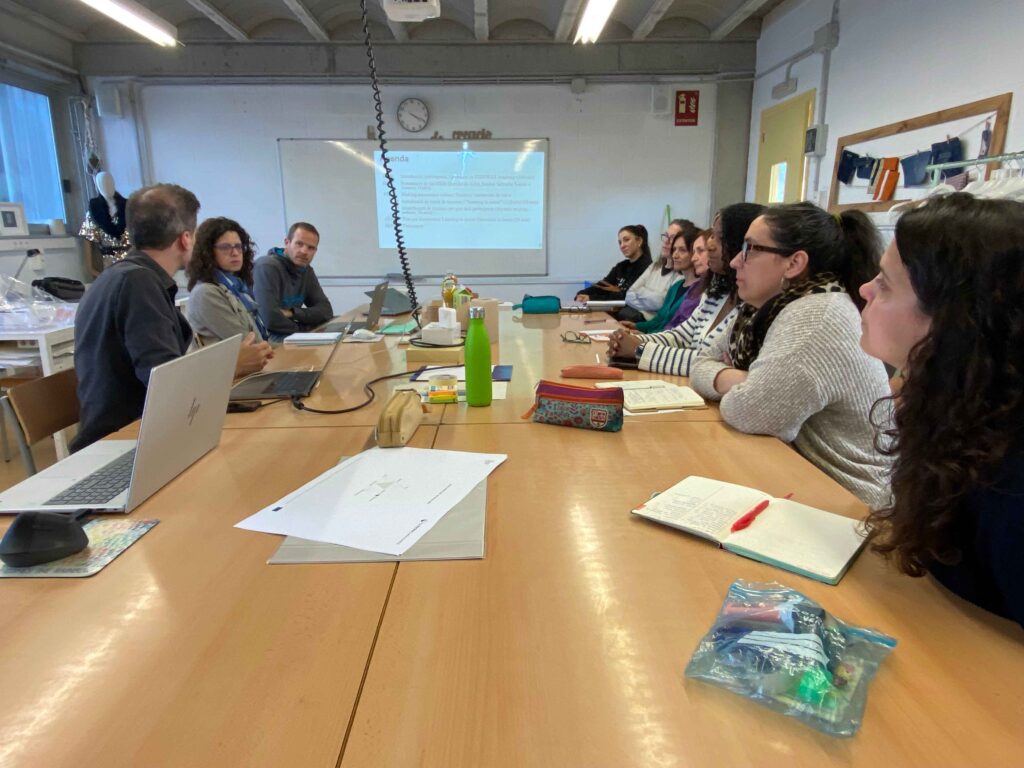
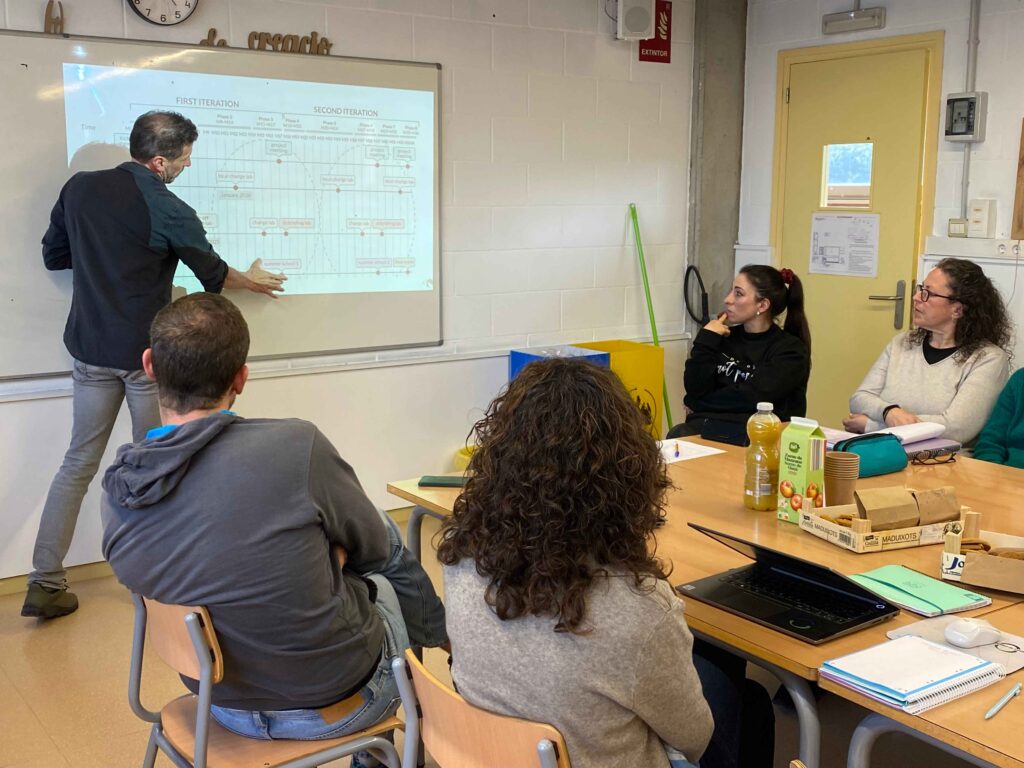
On 24 February 2026, the Spanish Open Schooling Network gathered at Institut de Celrà (Girona) for its first official Local Change Lab within the FEDORAS Teacher Academy. Teachers from two public secondary schools –Institut de Celrà and Institut Salvador Sunyer i Aimeric– met with researchers from the University of Girona, including a PhD student, and a pre-service teacher enrolled in the Master’s Degree in Secondary Education.
Although previous coordination meetings had already taken place and mobilised some of the Change Lab principles, this was the first formal Local Change Lab including multiple partners, and was designed as a shared space to pause, listen, and reflect together on questions of sustainability, interdisciplinarity, and assessment.
Sharing school realities
Following a round of presentations and an introduction to FEDORAS Academy’s main objectives and principles, the session began with presentations from the two secondary schools.
Institut de Celrà presented its consolidated project-based learning structure and the ongoing process of systematising the assessment of transversal competences. The school has designed new rubrics and tools to align projects with personal, social, and entrepreneurial competences, which are expected to be implemented across several subjects in the coming academic year. Their presentation highlighted the need for more coherent and shared tools to formally assess school-based projects.
Institut Salvador Sunyer i Aimeric (Salt) situated its work within a socially and culturally diverse school community, also facing structural constraints related to space and resources as well as to the socioeconomic realities of Salt. Teachers presented several interdisciplinary initiatives connected to the local environment and emphasised their commitment to linking the curriculum with the surrounding territory and fostering student agency and a sense of belonging.
As the discussion progressed, a shared concern became visible: the difficulty of making competences related to sustainability and agency more concrete and assessable within school structures that remain strongly organised around disciplines.
When theory meets classroom reality
A relevant moment in the session emerged from the intervention of the participating pre-service teacher, who shared her experience during her practicum and the difficulty of implementing competence-based education in upper secondary schools, particularly due to content pressure and preparation for university entrance examinations.
Her contribution opened a dialogue about the perceived distance between the competence-based curriculum framework and the concrete conditions of schools: limited time, subject-based organisation, external evaluation demands, and heavy content requirements.
The discussion highlighted the need to find viable ways of grounding the competence-based curriculum in real school contexts without oversimplifying its complexity.
From measuring to noticing
Building on the emerging discussions and a conceptual presentation on key FEDORAS concepts, the workshop proposed a conceptual shift: moving from a culture focused on measuring outcomes to one oriented towards learning to notice the expansive potentials that emerge in everyday practice.
Assessment was discussed as a collective practice of attentive noticing—not merely a matter of tools, but of shared decisions about what is considered relevant.
To analyse emerging tensions, Engeström’s (2001) activity system model was introduced as a framework to understand the relationships between the sometimes competing goals, rules, tools, division of labour, community, and outcomes that characterise educational activity systems.
Through discussion, several tensions were identified:
Time constraints for interdisciplinary collaboration.
Difficulties in coordinating teachers across subjects.
The complexity of assessing values, attitudes, and personal growth processes in formalised ways (vs informal means of assessment).
Frictions between sustainability as curricular content and sustainability as a transversal framework.
Institutional limits shaping and constraining what is possible.
The conversation did not resolve these tensions, but it allowed them to be articulated explicitly and collectively.
Emerging insights
By the end of the session, it became clear that assessment is not only a technical issue related to rubrics or instruments, but also a pedagogical stance: a question of what we truly value in educational processes and how we make it visible.
The Local Change Lab provided a dialogical space for teachers and researchers to share doubts, difficulties, and expectations and to initiate a joint analysis process that will continue in the next phases of the FEDORAS project.
The Italian National Change Lab was conceived as a moment of encounter between two Open Schooling Networks, each grounded in a distinct research culture and...
The Greek Local Change Lab, held on Sunday, January 25th, 2026, at the “XENIA” Student Cultural Center in Rethymno, brought together a diverse community of...
On January 27, the Finnish Open Schooling Network gathered for its first onsite Change Laboratory at the University of Helsinki. The Change Laboratory was a...
The Norwegian Open Schooling Network (OSN) has been firmly established and has arranged four physical meetings at the University of Oslo. In meetings, teachers and...