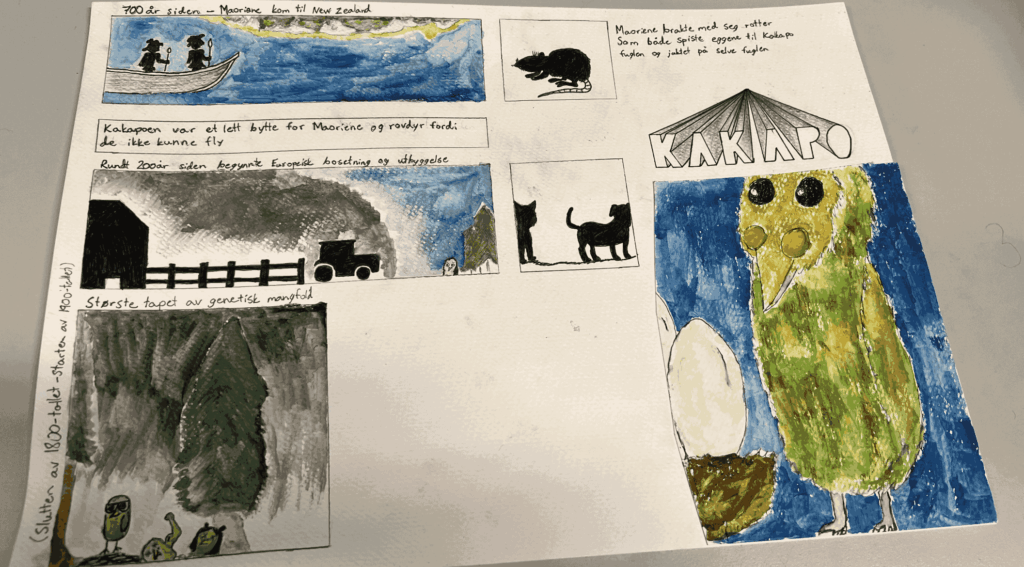
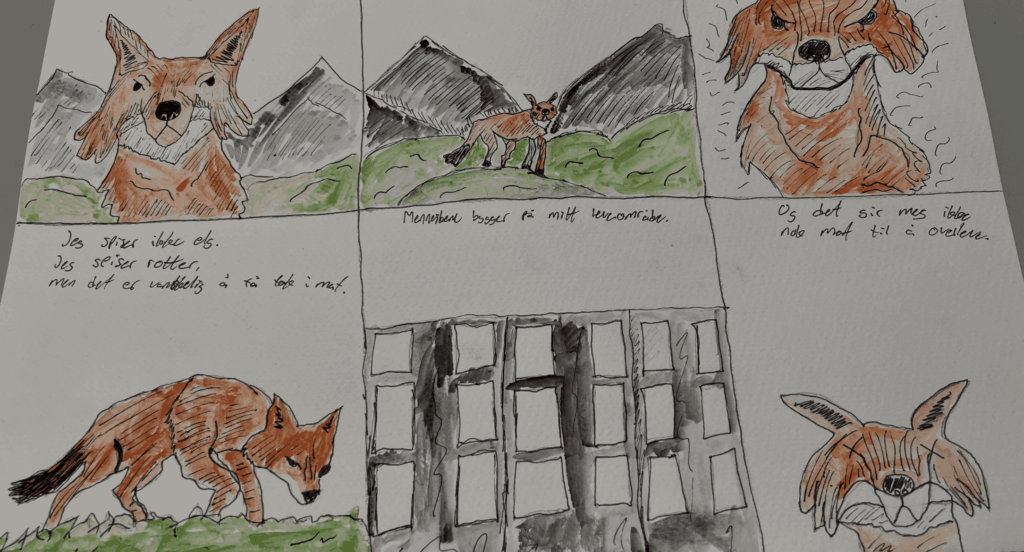
The Norwegian Open Schooling Network (OSN) has been firmly established and has arranged four physical meetings at the University of Oslo. In meetings, teachers and schools typically share planned, ongoing, or completed projects, which leads to open discussions and reflections. In the Norwegian network, we foreground sustainability issues, which often involve interdisciplinary and complex issues. Furthermore, we focus on how art-integrated approaches can contribute to transformative science learning. In this ripple, we will focus on one of these projects in which students were to make a comic about a species and its environmental challenges.
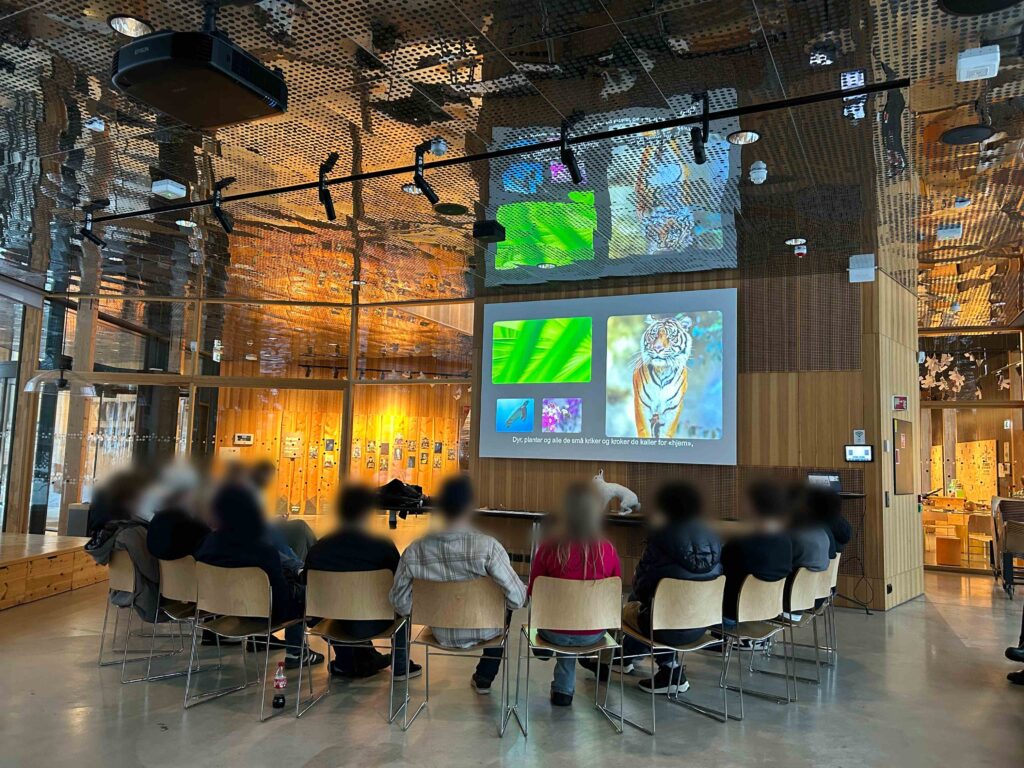
The project was carried out by all science and geography classes at Blindern Upper Secondary School. The project included a collaboration with the Norwegian Climate House, which is a part of the Natural History Museum in Oslo. At the Climate House, the students learned about environmental challenges that could threaten different species, including climate change, deforestation, and water scarcity.
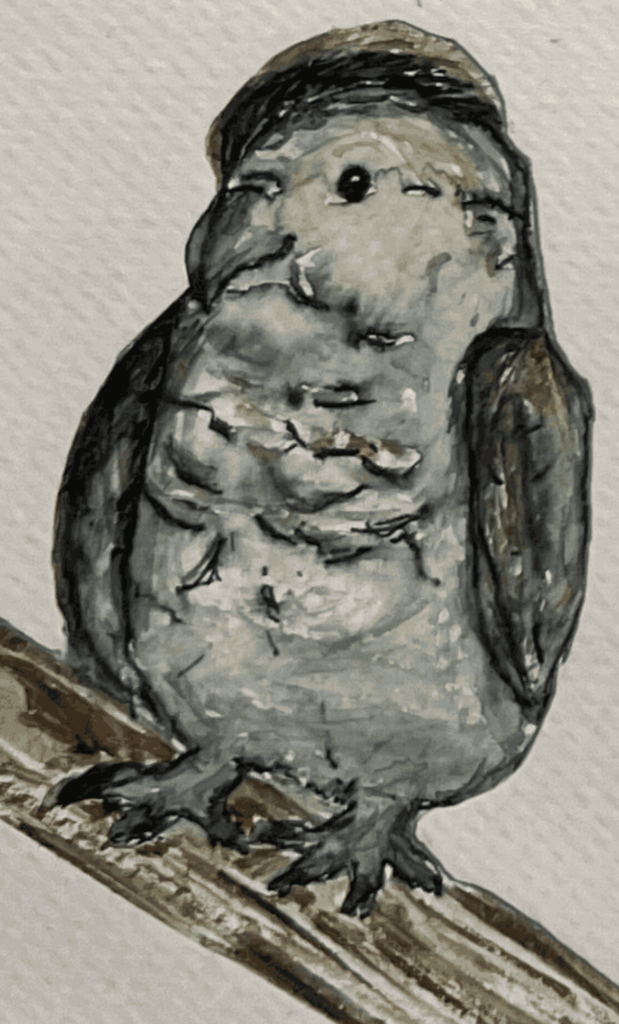
After the visit to the Climate House, the students started working on different species in different climate zones and explored how the species’ adaptation, or lack of adaptation, to the environmental challenges in the climate zone. The aim of including an aesthetic expression like comics was to explore the transformative potential of working with art for sustainability issues. Biodiversity loss is one of the major challenges we are facing, and we need to renegotiate our relationship to nature, moving away from an anthropocentric perspective. Comics and drawings offer semiotic resources that facilitate new ways of relating to the more-than-human. Close-up drawings and personification can convey empathy for animals and thereby help promote nature and sustainability values. Drawing and painting offer ways to relate to and emotionally engage with other species and their challenges. The students’ drawings communicated a range of emotions, including sadness, disgust, beauty, hopelessness, and wonder, but there is perhaps a lack of resources on how to deal with these emotions as they come up in science classes.
Further, making a comic involves creating a story that often extends into the future, requiring the envisioning of possible futures. However, many students have a rather deterministic view of the future. This is something to explore further in the network: how explicitly using future scaffolding techniques can support students’ futures literacy and how this resonates with art-integrated approaches.
Art-integrated approaches can also be a fruitful way of combining different knowledge systems and are therefore a fruitful way of working interdisciplinarily and across institutions. Drawing is both a universal language in everyday communication, but it is also used in the specialized language of science to communicate concepts and models. Another school that recently joined the Norwegian network, Hersleb upper secondary school, is planning a project that involves collaboration with artists and the local community, and we look forward to exploring and sharing our insights on how art-integrated approaches can contribute to transformative learning, futures literacy, and connecting schools with the wider community.
The Italian National Change Lab was conceived as a moment of encounter between two Open Schooling Networks, each grounded in a distinct research culture and...
On 24 February 2026, the Spanish Open Schooling Network gathered at Institut de Celrà (Girona) for its first official Local Change Lab within the FEDORAS...
The Greek Local Change Lab, held on Sunday, January 25th, 2026, at the “XENIA” Student Cultural Center in Rethymno, brought together a diverse community of...
On January 27, the Finnish Open Schooling Network gathered for its first onsite Change Laboratory at the University of Helsinki. The Change Laboratory was a...